Indian art
Pichwai Paintings: How to Spot a Print and What One Costs (2026)
We read 1,537 pichwai listings. Hand-painted costs $89 a sq ft, prints $38, and gold leaf adds nothing. How to spot a print, and who to buy from.
Which pichwai should you buy first?
3 questions, 20 seconds. Answers from our survey of 1,537 listings.
Question 1 of 3
What would you like it to show?
Question 2 of 3
What would you like to spend?
Question 3 of 3
Where will it hang?
Your answer
A small hand-painted piece
Start small. In our survey a hand-painted pichwai under 2 square feet (about 12 × 12 inches) cost a median $84, and 59% cost under $100. Buy one whose listing names the painter and the paint and cloth. If it costs under about $40 a square foot, or the description says canvas print, giclée or poster, it's a print.
Your answer
A cow or lotus pichwai from a named painter
Hand-painted cow and lotus pieces without a deity cost a median $131 in our survey, at about 2 square feet ($70 a square foot). Pay for the painter and the pigments, not the gold: listings that claim gold leaf cost no more per square foot ($84 against $91 without).
Your answer
A Shrinathji or festival pichwai from a painter you can name
Pieces showing Shrinathji, Krishna or a festival cost a median $743 in our survey, at about 7 square feet ($96 a square foot). The painter moves the price most: within one shop, painters' medians ran from $61 to $288 a square foot. Ask who painted it, in what pigments, and whether any part was sprayed.
Your answer
An old pichwai, bought at auction
Eighteen old pichwais sold at auction between 2008 and 2026 made a median $11,250 (about $255 a square foot, with the buyer's premium), and 4 sold below their low estimate. On marketplaces, 'antique' and 'vintage' are claims, not dates. Buy with a condition report, and expect wear.
New artists, by email
We're looking for Indian painters to work with. Join The Kanso Collective's list and we'll email you when new artists and new pieces arrive. Your first email has a personal 20% code for a first order with us.
One email with your code, then new designs. Unsubscribe any time.
A hand-painted pichwai painting costs a median $89 a square foot, and a printed one $38, so at the same size the hand-painted piece costs about 2.3 times as much. We read 1,537 pichwai listings on the sellers’ own pages on 26 and 27 October 2026: every pichwai at six specialist galleries, and the first results pages on seven marketplaces. The medians come from the 1,152 listings that showed a price and weren’t sold as antiques or digital files.
Our advice is to pay for the hand, not the gold. Listings that claim gold leaf, 8.5% of the hand-painted ones, cost no more per square foot: a median $84, against $91 for the rest. The painter moves the price far more. Within one shop, MeMeraki, one painter’s median is $61 a square foot and another’s $288, a spread of 4.7 times.
The word to distrust is “painting”. On the marketplaces, 48 of the 170 listings we read were prints, and 31 of those 48 called themselves a painting in the title or the first line. None of the 11 Amazon US listings was hand-painted. The specialist galleries did the opposite: 15 prints among 1,367 listings, and every one said it was a print.
A pichwai is a painted cloth made to hang behind the image of Shrinathji, the form of Krishna worshipped at Nathdwara in Rajasthan (V&A). This guide covers what pichwais show, how to spot a print, what an original costs by size and subject, where to buy one, and nine painters and studios working today.
We don’t sell pichwai paintings, and no shop or painter named here paid to be included. Every price is from the seller’s own page, read on 26 or 27 October 2026.
The short answer: what a pichwai painting costs
Our survey, 26–27 October 2026
Pichwai prices at a glance
| What you're buying | Median price | Median per sq ft | Listings | What it tells you |
|---|---|---|---|---|
| Hand-painted, under 2 sq ft (about 12 × 12 in) | $84 | $83 | 323 | 59% cost under $100 |
| Hand-painted, any size | $410 | $89 | 1,083 | Middle half $59–$138 a sq ft |
| Print (canvas, paper or poster) | $34 | $38 | 59 | Middle half $27–$53 a sq ft |
| Hand-painted cows or lotus, no deity | $131 | $70 | 300 | About 2 sq ft a piece |
| Hand-painted Shrinathji, Krishna or a festival (deity shown) | $743 | $96 | 616 | About 7 sq ft a piece |
| Hand-painted, gold or silver leaf claimed | – | $84 (without: $91) | 89 | No premium for the gold |
Asking prices on the sellers' own pages, read 26–27 October 2026: 1,537 listings, 1,367 at six galleries and 170 on seven marketplaces. Per square foot uses single, unframed panels with a stated size. Converted at $1 = ₹95.19 and £1 = $1.3348 (European Central Bank, 26 October 2026).
- Small hand-painted pichwais cost a median $84. That’s for pieces under 2 square feet, about 12 by 12 inches; 59% of the 323 we found cost less than $100.
- Prints cost a median $34 a piece, or $38 a square foot. Hand-painted pieces cost a median $410, or $89 a square foot.
- Gold leaf doesn’t raise the price per square foot in any size band: $84 with it and $91 without, overall.
- The painter moves the price up to 4.7 times within one shop: from $61 to $288 a square foot at MeMeraki.
- Cows and lotus ponds cost far less than Shrinathji: a median $131 a piece against $743, partly because they’re smaller (about 2 square feet against 7).
- The shop moves it four times: a median $64 a square foot at The India Craft House and $257 at Marble Lotus.
These are asking prices, taken from what each listing says; we didn’t inspect any painting. Rupee prices are converted at the European Central Bank’s rate for 26 October 2026 ($1 = ₹95.19), and pounds at £1 = $1.3348. In pounds, a hand-painted pichwai works out at about £67 a square foot, a print at £28, and a small hand-painted piece at £63.
What is a pichwai painting?
A pichwai is a cloth hung behind the image of Krishna in the shrines of the Pushti Marg, a Hindu devotional tradition. The V&A describes one as a “large painted cloth hung behind the stone relief sculpture of the extremely popular form of the god Krishna as Srinathji”, whose main temple is at Nathdwara. The Museum of Art & Photography in Bengaluru (MAP) calls pichwais “pictorial textiles made specifically for use as backdrops in the shrines of Shrinathji” (MAP on Google Arts & Culture).
The name says what the cloth does. LACMA translates pichhwai as “hanging behind”; MAP gives “that which hangs at the back”, and the Smithsonian derives it “from the Hindi word for “behind”” (Smithsonian Magazine). Many shop pages split the word into Sanskrit pichh (back) and wai (hanging). We found that split in one newspaper and in no museum.
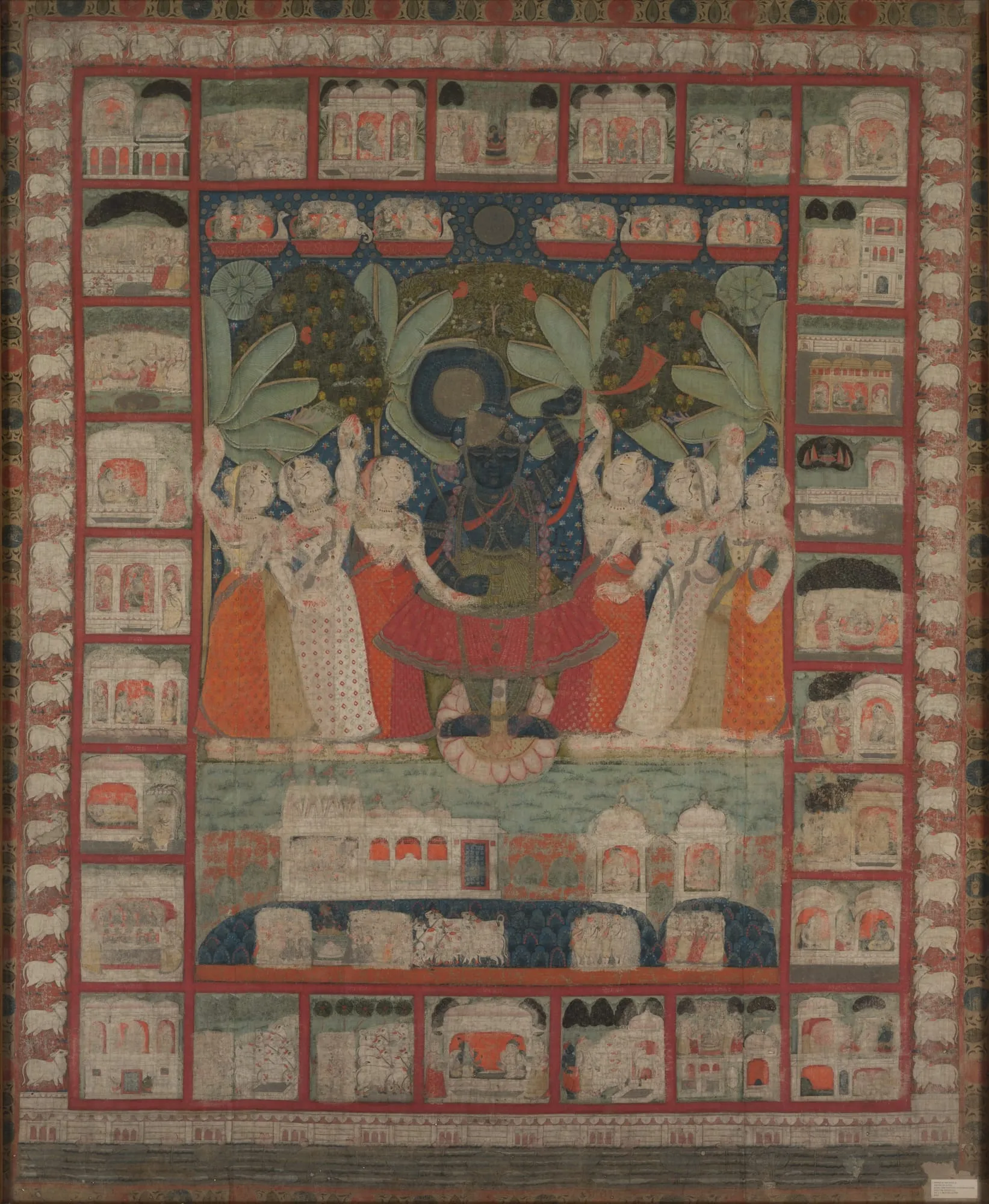
Shrinathji is Krishna at the age of seven. MAP describes the image “with his left arm held above his head, in the act of lifting Mount Govardhana to protect the people of Vraja”. The Pushti Marg, the “Path of Grace”, was founded by Vallabhacharya, who lived from 1479 to 1531 (Smithsonian Magazine). The image was moved to Nathdwara in 1671 or 1672: the V&A says 1671 and the Met 1672. Nathdwara is a town in its own right, 42 km north of Udaipur (Desmond Lazaro in Hinduism Today).
The hangings change through the day and the year. MAP counts “eight daily darshans (or formal viewings) and a year marked with 24 festivals particularly important to the Pushti Marg”, and says the pichwais “are changed daily, seasonally, and for various rituals and festive occasions in the temple”. Painted ones belong to the warmer months; in winter, “heavy brocades, zardosi, and khari works are deemed more appropriate” (MAP). Kay Talwar adds that painted pichvais don’t hang on Annakut or Janmashtami at Nathdwara either, though both are favourite subjects (Talwar, “Painted Pichvais”).
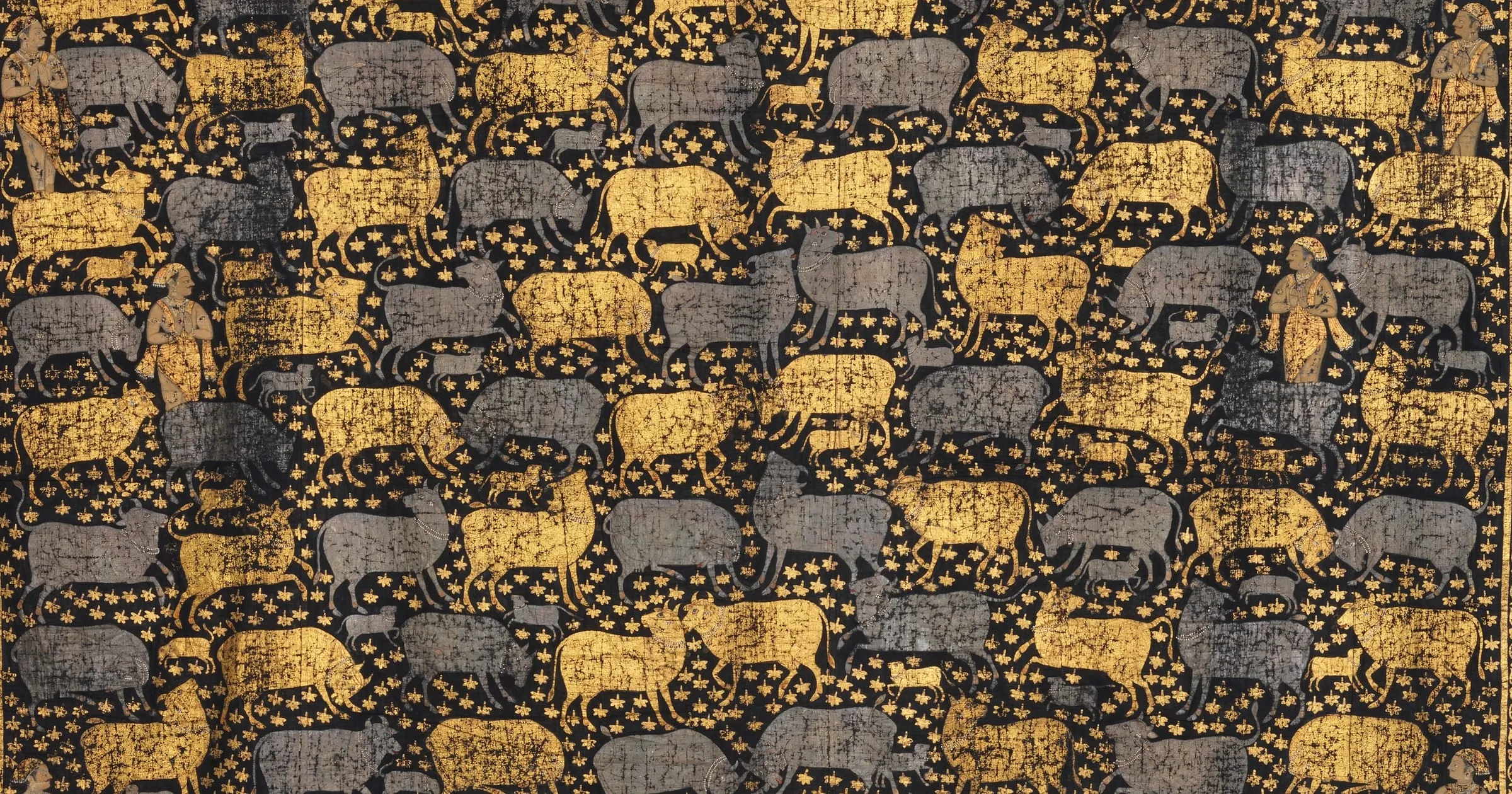
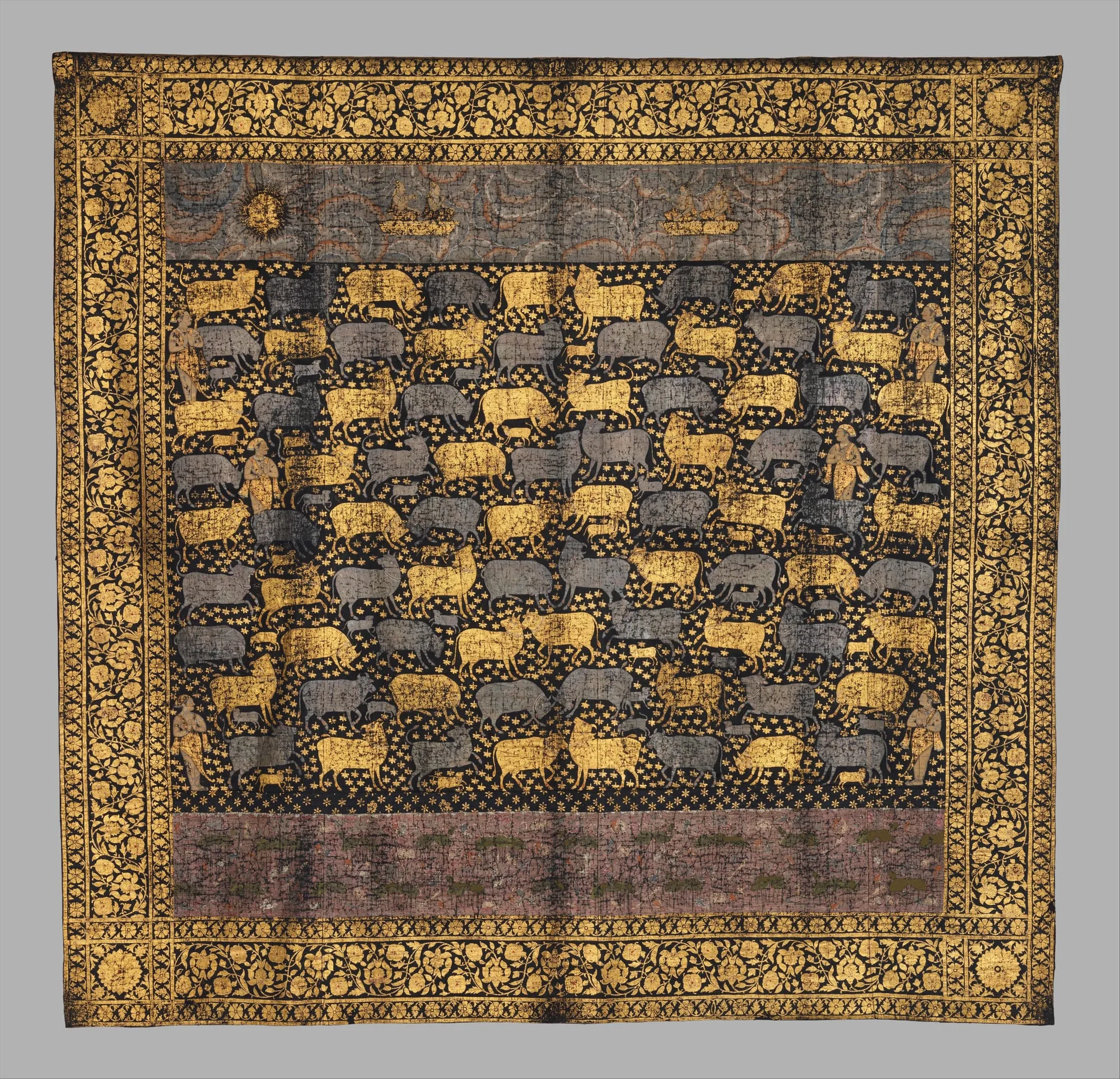
Not every pichwai is painted, and a printed one isn’t a fake. MAP lists pichwais “Painted on cotton; made of brocade and heavy silk; embroidered; painted and dyed; tinsel printed; block printed; even made of machine-made lace”. The Met’s 18th-century cow pichhwai at the top of this page is “Painted and printed gold and silver leaf and opaque watercolor on indigo-dyed cotton” (the Met). The trouble today isn’t printing. It’s a print that calls itself a painting.
Temple pieces were big: the Smithsonian’s 14 pichwais average “about eight by eight feet in size” (Smithsonian), and the largest is 77 square feet (Smithsonian). Most pichwais for sale now are far smaller: 323 of the 1,083 hand-painted listings we priced are under 2 square feet.
Is pichwai a 400-year-old art?
More than 350 years at Nathdwara, and about 300 for the oldest dated painted pichwais, but not 400. Shops say it is: Artisera’s pichwai page says the style “originated over 400 years ago”, and MeMeraki calls it “a 400 years old traditional artform”. The image reached Nathdwara in 1671–72. According to the Smithsonian’s curator, early pichwais “consisted mainly of floral or patterned cloths, usually hand-woven”, and artists began to paint on cotton in the mid-18th century (Smithsonian Magazine). The Met dates a painted pair from Kishangarh to about 1720–25 (the Met). Talwar, co-editor of a major pichwai catalogue, notes that pichvais were used in Vraj before 1671, but “it is uncertain when the first figural pichvai appeared”.
What do pichwai paintings show?
Mostly Krishna as Shrinathji, at a festival or in a season, and then the cows, lotus ponds, trees and gopis (cowherd women) of his world. Of the hand-painted pichwais we priced, 49% show Shrinathji or Krishna, 21% cows, 8% a named festival, 7% lotus ponds, 2% trees and 1% gopis; in all, 57% show a deity.
Shrinathji and the festivals. MAP calls Annakut “The most renowned festival of the Pushti Marg”. It marks Krishna lifting Mount Govardhan, its name means “mountain of food”, and the V&A places it “in the autumn during Diwali”. Sharad Purnima, when Krishna dances with the gopis under the autumn full moon, is “an extremely popular choice for pichwais” (MAP). MAP lists Daan Lila, Gopashtami and Janmashtami as “other common subjects”. Large pieces often frame the scene with small panels of the year’s darshans: the V&A’s has 28 of them (V&A).
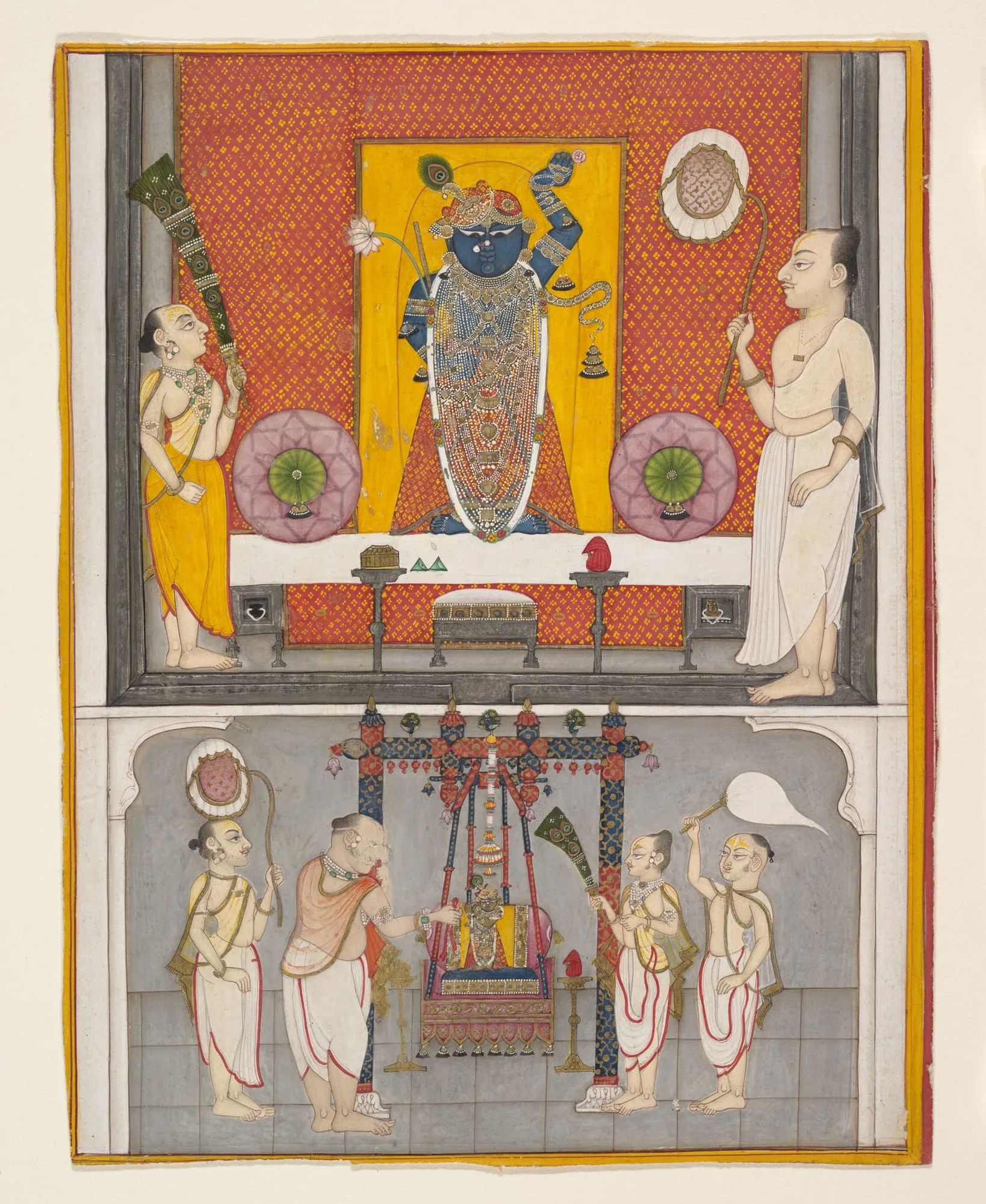
Made for worship. At Nathdwara the hanging has an opening for the image, an “inverted U”; “In other temples and private shrines, the pichvai is an unperforated rectangle of cloth” (Talwar). The Met notes that pichwais “served as backdrops to the black stone icon, and as substitutes for it when worshipped away from Nathdwara” (the Met). So a Shrinathji pichwai is a devotional image first, made to be worshipped as well as looked at.
Cows. Gopashtami, the Festival of Cows, “occurs in the late autumn to celebrate Krishna’s elevation from a herder of calves to a cowherd” (the Met). On that day, MAP says, the temple cows are “adorned with henna and sindur hand prints, peacock plumes and with bells around their necks”. By the 19th century, Madhuvanti Ghose writes, the Nathdwara style was known for “dreamy-eyed cows” (AD India), and the Cleveland pichvai above has “a border of adoring cows”. Sellers title many cow paintings Kamdhenu, after the wish-granting cow of Hindu tradition; we found no museum or scholar linking her to temple pichwais, so read that as a modern subject.
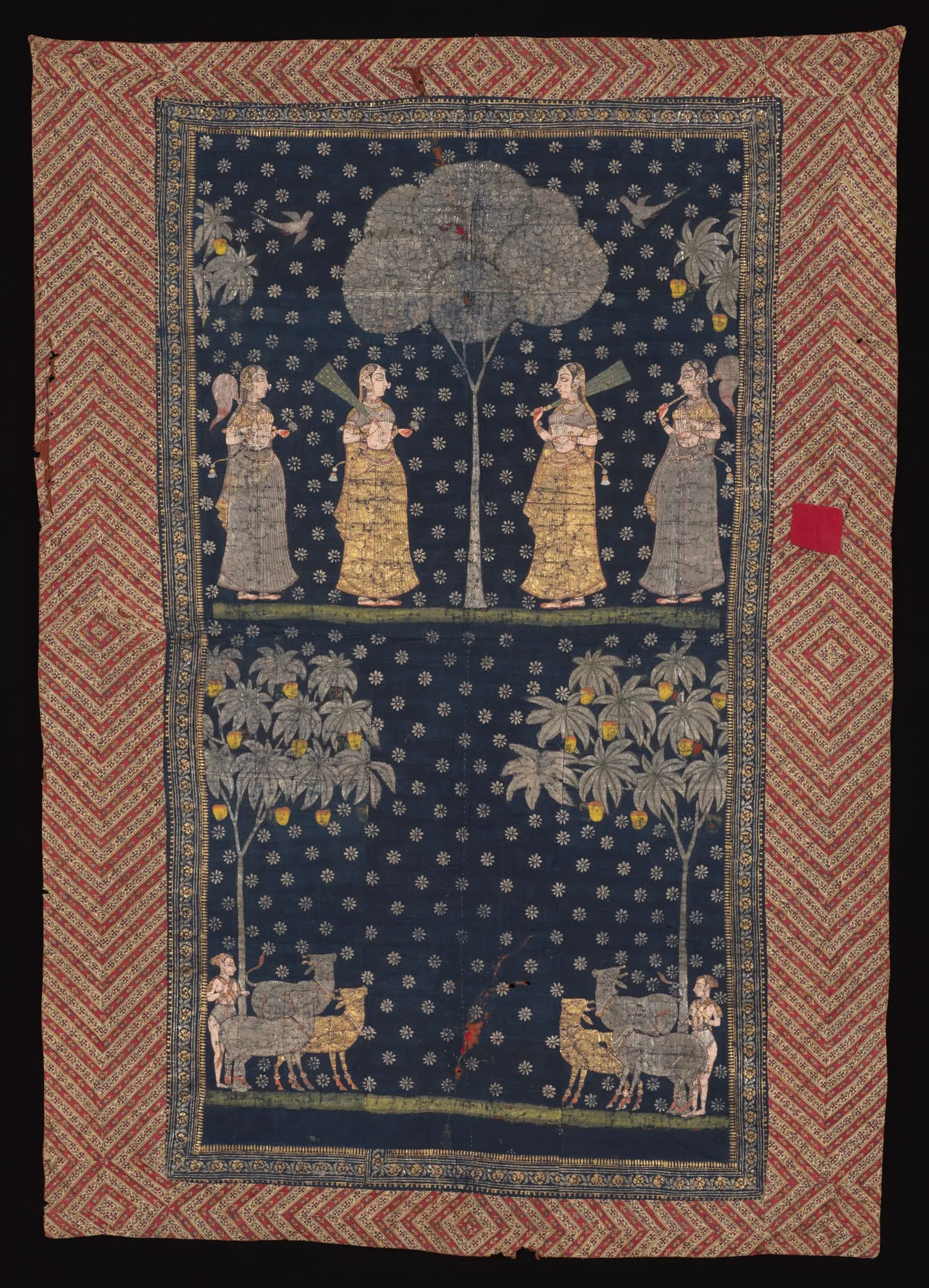
Lotus ponds, trees and peacocks. In summer, MAP says, the pichwais “are often of the Kamal Vana or Jal Vihar categories, featuring lotuses and water bodies, and meant to provide Shrinathji respite from the sweltering heat”; a Christie’s catalogue says lotus picchvais are used “to create a cool atmosphere in the shrine” (Christie’s). Sellers often call these kamal talai, a name the museums we read don’t use. In tree (Vrikshachari) pichwais Krishna is “only symbolically represented”, usually by the kadamba tree (MAP), and monsoon Morakuti pichwais show peacocks “dancing in full abandon in the rainy season”.
Modern pichwai. Few of today’s listings are experimental: 28 of the 1,031 hand-painted listings we priced per square foot call themselves modern, contemporary, abstract or something similar in the title, at a median $52 a square foot, and half of those are from one gallery. The bigger change is who paints for whom, which the painters’ profiles below show.
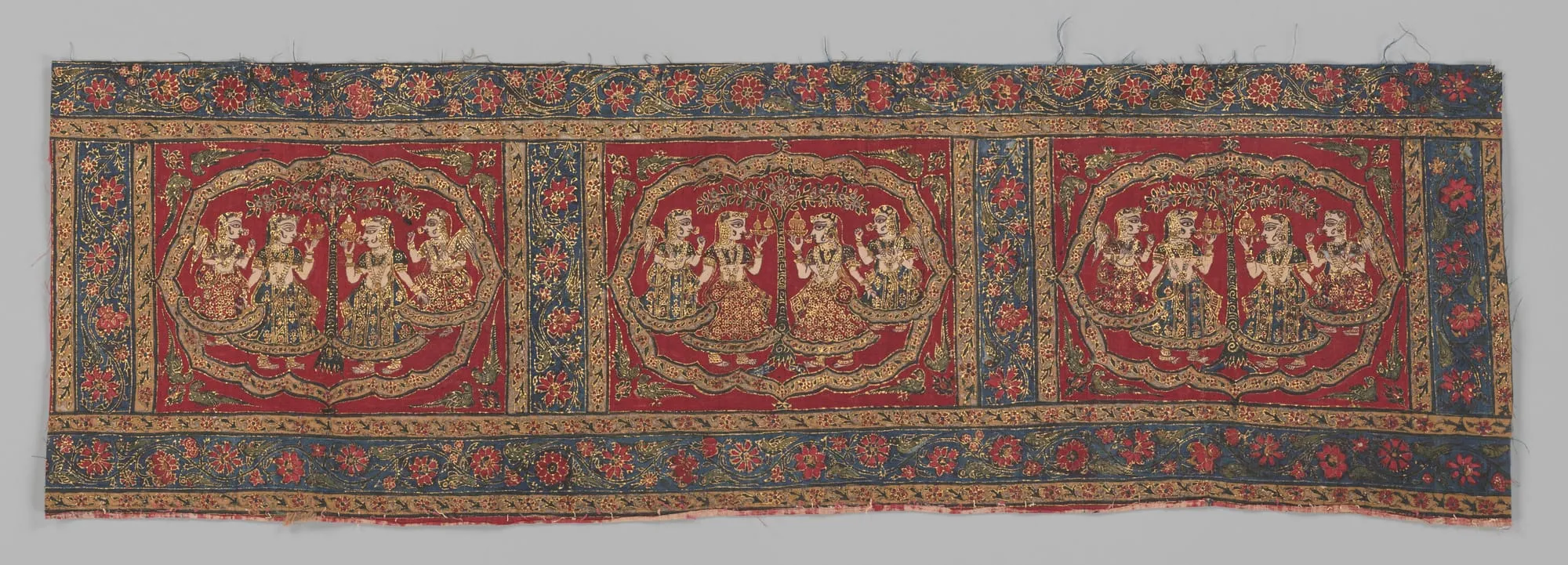
How to tell a hand-painted pichwai from a print
Read the description, not the title. Of the 48 prints we found on marketplaces, 31 called themselves a painting in the title or the first line, and the words that gave each one away sat further down: canvas print, giclée, latex inks, UV printing, poster. We found no museum or named expert that publishes a pichwai-specific test, so the checks below come from reading 1,537 listings, with sellers’ own advice marked as theirs.
Prints sold as paintings: the listings' own words
Title says painting, description says print
| Listing | Price | What the listing says, both sides |
|---|---|---|
| Etsy, RUDRABHAV | $48.38 | Title: 'Sacred cow painting, pichwai cows artwork' vs description: '-NOT a hand-painted original' / '-Printed canvas texture (no real brushstroke texture)' |
| Etsy, HomeLuxuryTouch | $46.80 | Title: 'Pichwai Cow Wall Art Sacred Indian Lotus Canvas Painting' vs 'This is Canvas Print.' |
| Etsy, InrWallArt | $18.99 | Title: 'Lotus Flower Pichwai Canvas Wall Art, Indian Oil Painting, Botanical Print' vs 'Printed using archival, UV protected inks' |
| Amazon US, EL CORTEZ | $31.88 | Title: 'Pichwai Cow Wall Art, Sacred Indian Lotus Canvas Painting' vs 'High Definition Giclee modern canvas printing artwork, picture photo printed on high quality canvas.' |
| Amazon US, zhaoningjun | $12.00 | Title: 'Krishna Radha Forest Pichwai Indian Miniature Painting Poster' vs 'Equipped with high-definition precision printing technology, this canvas print boasts crisp line details' |
| Amazon UK, zig zag | £70.00 | Title: 'zig zag PICHWAI Painting Picture Framed' and 'Is original artwork: Yes' vs bullet: 'This Photo Comes With Printed Photo Frame' |
Read on each listing page on 27 October 2026. We record what the listing says; we didn't buy or inspect any of them.
- Search the description for print words. Canvas print, giclée, HD, UV printing, latex or archival inks, poster, digital print and “printed on” all mean a print, whatever the title says.
- Find the medium line. A hand-painted listing says what paint is on what cloth. MeMeraki’s pages carry lines such as “Natural Colors on Cloth”, Marble Lotus’s say “Mineral Paints on Linen Cloth, One-of-a-kind Original Artwork”, and ArtFlute lists Kuldeepak Soni’s work as “Natural Stone Colour on Cotton Cloth”. A print names a canvas, a paper or a frame, and no paint.
- Look for the painter’s name. 76% of the hand-painted listings named a painter. The India Craft House doesn’t name painters on its listings, so a missing name is a question to ask, not proof of a print.
- Work out the price per square foot. Prints in our survey cost a median $38 a square foot, with the middle half between $27 and $53. Hand-painted pieces cost $89, with the middle half between $59 and $138. Under about $40 a square foot, ask before you buy; the price check further down does the sum.
- Don’t rely on a marketplace’s tick-boxes. One Amazon UK listing for a framed “PICHWAI Painting” shows “Is original artwork: Yes”, while its own bullet point says “This Photo Comes With Printed Photo Frame”.
- Ask three questions. Who painted it? What paint, on what cloth? Can you send a close-up of the brushwork and of the back? Some sellers suggest checking the back for “faint paint marks or color penetration” (Jaipur Earth); that’s a seller’s advice, not a museum’s.
- Expect shortcuts even in hand-painted work. In 2008 the painter and author Desmond Lazaro found an airbrush in a commercial studio, “used to quickly fill in the background areas of paintings” (Hinduism Today). In 2017 Pooja Singhal told the Indian Express that “Many of the young artists make the base of the painting using a spray gun” (Indian Express). And a restorer told the Hindustan Times of a “painting” that “turned out to be a digital print on canvas”, with its edges done in oil paint (Hindustan Times); that one wasn’t a pichwai, but the trick travels.
What does an original pichwai painting cost?
A hand-painted pichwai costs a median $410, and size sets most of the price. Per square foot, the median moves only from $83 under 2 square feet to $113 at 16 square feet and over, so the price of a piece climbs with the cloth: a median $84 for the smallest and $2,344 for the largest. Enter a listing’s size and price below to see where it sits.
Our dataset, 26–27 October 2026
What a pichwai costs by size, and a price check
Hand-painted listings against prints, per square foot. Enter a listing's size and price below to see where it sits.
| Size | Hand-painted: median a piece | Hand-painted: per sq ft (middle half) | Print: per sq ft | Gold leaf claimed vs not, per sq ft |
|---|---|---|---|---|
| Under 2 sq ft 12 × 12 in (30 × 30 cm) is 1 sq ft | $84 (n 323) | $83 ($63–$123) (n 310) | $37(n 34) | $81 vs $84 (n 11 vs 299) |
| 2 to 6 sq ft 18 × 24 in (46 × 61 cm) is 3 sq ft | $320 (n 196) | $94 ($56–$172) (n 173) | $40(n 9) | $94 vs $94 (n 4 vs 169) |
| 6 to 16 sq ft 36 × 48 in (91 × 122 cm) is 12 sq ft | $946 (n 426) | $88 ($51–$133) (n 419) | none found | $82 vs $88 (n 57 vs 362) |
| 16 sq ft and over 48 × 72 in (122 × 183 cm) is 24 sq ft | $2,344 (n 132) | $113 ($70–$169) (n 129) | none found | $88 vs $116 (n 17 vs 112) |
Single, unframed hand-painted panels with a stated size; prices of the smallest size offered. The middle half runs from the 25th to the 75th percentile. Gold leaf counts only explicit claims in the listing. The check compares a listing with all 43 prints we priced per square foot (median $38); we found none over 6 sq ft.
Gold leaf doesn’t raise the price
Listings that claim gold or silver leaf cost a median $84 a square foot; listings that don’t, $91. That holds in every size band in the table above. Under 2 square feet it’s $81 against $84, and at 16 square feet and over it’s $88 against $116. Gold-leaf pieces do cost more as whole pieces, a median $1,040 against $378, because they’re bigger. You may read that gold leaf makes a pichwai much more expensive. Per square foot, the asking prices say otherwise. We counted only explicit claims (8.5% of hand-painted listings), so “no claim” doesn’t mean “no gold”.
Gold has a long history in pichwais. The Smithsonian’s study of 14 of them found “tin and gold leaf” among the materials, and in one “the shiny gold decorations are made from real gold” (Smithsonian). The point isn’t that the gold is fake. It’s that sellers don’t charge more per square foot for it, so there’s no reason to pay more for it.
Pay for the hand, not the gold: pichwais that claim gold leaf cost no more per square foot than those that don’t.
The painter moves the price most
Within one shop, on one day, painters’ medians run from $61 to $288 a square foot. MeMeraki names the painter on its listings, so it’s the cleanest test we have: same shop, same currency, same day.
One shop, one day: MeMeraki, 27 October 2026
Price per square foot by painter
| Painter (as MeMeraki spells the name) | Median per sq ft | Listings with a size |
|---|---|---|
| Shehzaad Ali Sherani | $61 | 236 |
| Sushil Soni | $84 | 19 |
| Naveen Soni | $88 | 123 |
| Dinesh Soni | $118 | 180 |
| Jayesh Sharma | $122 | 71 |
| Mohan Prajapati | $156 | 6 |
| Trilok Prakash Soni | $250 | 10 |
| Kailash Sahu | $263 | 7 |
| Suresh Kumar Kumawat | $288 | 13 |
Hand-painted single panels with a stated size; painters with six or more such listings. Each name links to the painter's page on MeMeraki. MeMeraki prices are in rupees, converted at $1 = ₹95.19 and £1 = $1.3348 (European Central Bank, 26 October 2026).
Pigment comes second. MeMeraki tags its listings by paint: natural colours cost a median $110 a square foot (419 listings) and poster colours $61 (203). Under 2 square feet there’s no gap, $84 for both, and painters favour different paints, so part of that difference is the painter again.
Cows and lotus cost far less than Shrinathji
A hand-painted cow or lotus pichwai with no deity costs a median $131; one showing Shrinathji, Krishna or a festival costs $743. Most of the gap is size (about 2 square feet against 7), and the rest is detail: $70 a square foot against $96. Very large pieces are the exception. At 16 square feet and over, pichwais without a deity cost more per square foot ($144, 30 listings) than those with one ($97).
Old pichwais at auction
At auction, 18 old pichwais sold between 2008 and 2026 made a median $11,250, about $255 a square foot, with the buyer’s premium, converted at 26 October 2026 rates. The range is wide. The cheapest, a worn Gopashtami cow pichhwai of 43 square feet, made $570 in 2013; a late-19th-century Annakut scene made $75,000 at Bonhams New York in 2018; and a summer lotus picchvai made £43,750 at Christie’s London in 2016. Four of the 18 sold below their low estimate. Two Indian sales, at Saffronart and AstaGuru, were registered antiquities that can’t leave India.
On marketplaces, “antique” and “vintage” are claims, not dates. Thirty-six listings made them (31 of them on marketplaces), and one Etsy shop tags every listing “Vintage from the 1980s”, including ones titled “Vintage Style” and “Antique Finish”. We left all 36 out of the medians.
Why we’d start with a cow or lotus pichwai
If you’re buying your first pichwai, start with the cows. A small hand-painted piece under 2 square feet costs a median $84, and 59% cost under $100; a cow or lotus piece of about 2 square feet costs a median $131. That’s a hand-painted piece for $50 more than the median print.
Collectors and ateliers say the same. Pichvai Tradition & Beyond, an atelier in Udaipur, says it introduced its cow works “as an accessible starting point for those beginning to collect traditional Indian art” (its Instagram), and its 2025 London show sold “Pichwais under £200” (Financial Times). The collector Amit Ambalal bought his first pichwai, an 18th-century Gopashtami, in 1960, aged 17, for ₹150, and “that raggedy ‘Gopashtami’ remains the best pichwai in his collection” (The Hindu).
There’s a second reason. A Shrinathji pichwai is made for worship. If you want a painting for a living room rather than a shrine, cows, lotus ponds, trees and peacocks carry the Nathdwara style without the deity. If you do want Shrinathji, buy from a painter you can name, in the pigments you asked for: that’s where the money should go.
Where you buy sets the price
The same kind of hand-painted pichwai costs four times as much per square foot at one gallery as at another: a median $64 at The India Craft House, $88 at MeMeraki, $129 at Artisera and $257 at Marble Lotus. Across the galleries the median is $94 a square foot; across the marketplaces, $56.
One title shows the gap directly. Exotic India’s Lord Shrinathji Playing Flute In Forest (code PAB421, 36 × 24 inches) cost $288 on exoticindiaart.com and $479.99 on Wayfair, listed under Exotic India’s name, on 27 October 2026: 67% more. We didn’t compare the photographs.
Two galleries hide most prices. Artisera shows “Price on Inquiry” on 97 of its 234 pichwai pages, mostly sold pieces, and ArtZolo shows “Not Available for Sale” on 248 of its 258. The Indian galleries also price in rupees for overseas visitors (MeMeraki’s pages read “Pay ₹5,000 one-time”, for example), so the dollar figure moves with the exchange rate. Shipping and import duty aren’t in these figures, though Exotic India’s US prices include tariffs and taxes. Compare the delivered price before you buy.
Our survey, 26–27 October 2026
What each shop charges for a hand-painted pichwai
| Shop | Type | Median per sq ft | Median a piece | Hand-painted listings priced | Prints found |
|---|---|---|---|---|---|
| Marble Lotus | Gallery | $257(n 44) | $1,905 | 44 | 0 |
| Artisera | Gallery | $129(n 135) | $1,324 | 137 | 0 |
| MeMeraki | Gallery | $88(n 665) | $378 | 672 | 0 |
| Wayfair | Marketplace | $80(n 9) | $428 | 10 | 0 |
| The India Craft House | Gallery | $64(n 44) | $106 | 66 | 0 |
| ArtZolo | Gallery | $57(n 10) | $1,051 | 10 | 0 |
| Exotic India Art | Marketplace | $56(n 33) | $316 | 39 | 0 |
| Etsy | Marketplace | $43(n 22) | $199 | 29 | 25 (median $25) |
| eBay | Marketplace | $30(n 5) | $130 | 6 | 0 |
| Amazon US | Marketplace | – | – | 0 | 9 (median $26) |
| Amazon UK | Marketplace | – | – | 1 | 10 (median $49) |
Galleries: every pichwai in the shop's own collection. Marketplaces: the first one or two results pages of one search. n = hand-painted single panels with a size. Prices on each seller's own page, read 26–27 October 2026; converted at $1 = ₹95.19 and £1 = $1.3348 (European Central Bank, 26 October 2026).
Where to buy a pichwai painting
Buy from a gallery that names the painter and the medium, or from the painter direct; on a marketplace, read every description. Here’s what each shop we surveyed sells, from its own pages on 26 and 27 October 2026, in order of median price per square foot.
- Marble Lotus ($257 a square foot; median $1,905 a piece; 44 listings). The dearest per square foot. Its pages describe the pieces as “Mineral Paints on Linen Cloth, One-of-a-kind Original Artwork” and price them in dollars.
- Artisera ($129; $1,324; 137 priced of 234). Names its painters and sells Shan Bhatnagar’s work; many sold pieces show “Price on Inquiry”.
- MeMeraki ($88; $378; 672 listings). The largest collection we read, with the painter named on each listing and the paint tagged. Most pieces are made to order, and prices are in rupees.
- The India Craft House ($64; $106; 66 listings). The lowest price a piece among the galleries. The description shared by all 66 says “Hand-painted on starched cotton or handwoven cloth using natural pigments”; the listings don’t name painters.
- ArtZolo ($57; $1,051). Mostly a record of sold work: 10 of its 258 pichwais had a price.
- Exotic India Art ($56; $316; 39 listings). A large catalogue (347 results for pichwai), with the medium on each listing, such as “Natural Color on Cloth”, and a “100% Handmade” badge.
- Wayfair ($80; $428; 10 listings). Seven of the ten were Exotic India pieces.
- Etsy ($43; $199; 29 hand-painted and 25 prints). Half and half, so read every description. Another 14 listings claimed to be vintage or antique.
- eBay ($30; $130; 6 listings). A small sample: 9 of the 15 we read claimed to be antique or vintage.
- Amazon. In the US, 9 prints and 2 listings that don’t say; none hand-painted. In the UK, 10 prints, 1 hand-painted piece and 2 that don’t say.
- 1stDibs. All 7 we read claimed to be antique or vintage, so they’re outside the medians.
Who paints pichwais today?
Hereditary painters in and around Nathdwara, a few ateliers, and a handful of artists who’ve taken the style elsewhere. MAP names three communities of Nathdwara painters, “the Adi Gaur and the Jangid, and the lesser known Mewaras”, and Madhuvanti Ghose counted “over 300 artists” still living and working in Nathdwara in 2022 (AD India). For a long time the painters went unnamed: “Few pichwai artists signed their work until the rise of Ghasiram Hardev Sharma around the late 19th century or turn of the 20th century” (Smithsonian Magazine). Today many sell under their own names, online and by direct message.
Here are nine painters and studios selling today, in alphabetical order. Each profile draws on their own pages first, then the shops that sell their work, then the press. Prices are in rupees where that’s how the shop shows them.
Dinesh Soni, Bhilwara
Dinesh Soni is a third-generation pichwai painter in Bhilwara, Rajasthan. MeMeraki says he learned from his grandfather, Badrilal Chitrakar, and his father, Prabhulal, and that he holds a Bachelor of Fine Arts from MDS University in Ajmer. The Government of India’s list of National Awardees for 2019 includes him, filed under the craft “Warak Printing” (Press Information Bureau). He paints in natural pigments with gold and silver leaf, on cloth, paper and canvas. Cows recur: The Two Kamdhenus sets two mirrored cows on a chevron ground. At MeMeraki his work costs a median $118 a square foot (180 listings).
Instagram @dineshsoni9039 · sold by MeMeraki, Bridge Bharat and Baroart
Jayesh Sharma, Nathdwara
Jayesh Sharma paints pichwai in Nathdwara, where MeMeraki says he was born; his Instagram bio reads “Pichwai artist since 20 years”. MeMeraki and The Artists of Nathdwara both say his grandfather Gangaramji Sharma’s work was displayed at the Bhuleshwar temple in Mumbai. Besides Shrinathji and Raas Leela scenes, he paints small cow, lotus and peacock pieces, which MeMeraki lists at ₹5,000 (about $53) each. His MeMeraki median is $122 a square foot (71 listings). He rarely posts on Instagram (last in March 2024), so MeMeraki is the easier route.
Instagram @jayesh_pichwai · sold by MeMeraki · listed by The Artists of Nathdwara
Naveen and Kuldeepak Soni (Pichwai Store), Bhilwara
Pichwai Store is the shared Instagram account of the brothers Naveen and Kuldeepak Soni, third-generation painters from Bhilwara. Both trained under their grandfather, Shilp Guru Badrilal Chitrakar, and their father, Sharad Soni. They paint with natural stone pigments and gold leaf on cloth and paper. Alongside Shrinathji scenes, Naveen paints cows and square lotus works such as The Pink Lotus (₹45,000, about $473, on MeMeraki), and his MeMeraki median is $88 a square foot (123 listings). Kuldeepak’s large festival pieces sell on ArtFlute, at $276 to $2,722 for the 11 priced there.
Instagram @pichwaistore · Naveen’s work at MeMeraki and Shwayaa · Kuldeepak’s at ArtFlute · orders by Instagram message (“Shipping worldwide”, says the bio)
Pichvai Tradition & Beyond, Udaipur
Pichvai Tradition & Beyond is an atelier in Udaipur run by Pooja Singhal, who says she began reviving pichvai in 2009. In Global Indian’s account she commissions the works, runs the atelier and acts as its gallerist and curator, while a team of 10 to 12 artists paints, according to Eastern Eye. The atelier uses hand-ground mineral pigments on cloth, and its work runs from Shrinathji darshans to a greyscale series and small cow paintings. In July 2025 it showed more than 350 works at the Mall Galleries in London. It publishes no prices; catalogues come by Instagram message.
Instagram @pichvaitraditionandbeyond · Global Indian profile
Rajaram Sharma, Udaipur
Rajaram Sharma was born in 1963 in Bijoliya, in Bhilwara district, and trained in Nathdwara from the age of 13 under Tulsidas Chitrakar. He lives and works in Udaipur, where he runs the Chitrashala studio and teaches. His pichwais for sale show Shrinathji and festival scenes, among them Jal Vihar and Gopashtami in The Artists of Nathdwara’s catalogue. His small miniatures on paper are different: they leave people out “to explore the haunting spirit of deserted kingdoms and the disappearance of water”, as Victoria Munroe Fine Art in New York put it when it showed them from 23 June to 10 October 2026. He holds a National Merit Certificate (2016).
Instagram @artist_rajaram_sharma_studio (sometimes posted by his son) · Gaatha (pre-order, “Call For Price!”) · The Artists of Nathdwara · Victoria Munroe Fine Art
Shammi Bannu Sharma, Jaipur
Shammi Bannu Sharma paints Indian miniatures and pichwai in Jaipur and describes himself as a seventh-generation artist. He trained under his father, Ved Pal Sharma “Bannu”, and his bio lists a National Award for 2014. AD India reports that he “still grinds his own mineral pigments and gold paint by hand, and has run restoration workshops at London’s Victoria and Albert Museum” (AD India). He paints Krishna and temple scenes, cows (Krishna’s Cows, 2026) and lotus ponds; Govind Sarovar, finished in October 2026, is a lotus pond across two panels. He works to commission and publishes no prices.
Instagram @shammibannusharma · enquiry form on Linktree
Shan Bhatnagar, Jaipur
Shan Bhatnagar is a self-taught painter, interior designer and hotelier in Jaipur. currentMood reports that a visit to the Govind Devji temple in 2004 turned him to painting Krishna. He reworks the Nathdwara darshan on canvas in layered acrylic, stitched textile and jewellery, and has said his paintings “are not Pichwai in the traditional sense” (The Hindu). Artisera, which sells his originals, lists Shrinathji paintings and Cows (Set of 4), acrylic and foil on canvas, 24 × 24 inches; every price there is on inquiry.
Instagram @shaanse_jaipur · sold by Artisera
Shehzad Ali Sherani, Kishangarh
Shehzad Ali Sherani paints Kishangarh miniatures and pichwai in Kishangarh, Rajasthan, where he was born. His Instagram bio lists a Rajasthan Lalit Kala Academy commendation and a State Award. MeMeraki, which sells his originals and spells his name Shehzaad, says he trained under Padma Shri Kripal Singh Shekhawat. Besides Shrinathji, he paints cows, lotus ponds and peacocks: Twelve Cows in Pichwai is a square canvas of ornamented cows on a red ground. MeMeraki has more of his work than any other painter’s, 236 sized listings at a median $61 a square foot, the lowest in the table above; most are tagged poster colours. He takes orders by direct message.
Instagram @pichwai_shehzadali · sold by MeMeraki
The Artists of Nathdwara
The Artists of Nathdwara (AoN) is an organisation of hereditary pichvai painters in Nathdwara, not a single artist. Its website says it was founded on 30 December 2014 “with the guidance of Dr Madhuvanti Ghose, curator of Indian art at the Art Institute of Chicago”, that more than 100 artists are associated with it, and that three of its painters head it. It names 24 artists, including Jayesh Sharma and Rajaram Sharma, and takes orders and commissions by email and phone. Its catalogue of 63 works includes Kamal Talai (lotus pond) and Gocharan (cow-herding) pichvais, with no prices shown.
Website · catalogue · Instagram @artistsofnathdwara
What we’d do
- Under $150: a small hand-painted cow, lotus or peacock piece from a named painter, with a medium line that names the paint and the cloth.
- $150 to $1,000: a cow or lotus pichwai of 2 to 6 square feet in natural colours, bought for the painter, not for gold leaf.
- For a shrine: a Shrinathji pichwai from a painter you can name. Ask what pigments they use and whether any part is sprayed or stencilled.
- Never pay painting prices for a listing whose description says canvas print, giclée or poster. Under about $40 a square foot, treat it as a print until the seller shows you otherwise.
- For an old piece: buy at auction with a condition report, and expect wear. The Cleveland Museum of Art notes that old temple pichvais “are usually faded and worn”.
FAQ
How much does a pichwai painting cost? A hand-painted pichwai costs a median $410, or $89 a square foot, in our survey of listings at six galleries and seven marketplaces on 26–27 October 2026. Small pieces under 2 square feet cost a median $84, and 59% cost under $100; pieces of 16 square feet and over cost a median $2,344. A print costs a median $34. Old pichwais at auction made a median $11,250 across 18 sales from 2008 to 2026.
How can you tell if a pichwai is hand-painted or a print? Read the whole description, not the title. In our survey, 31 of 48 marketplace prints called themselves a painting in the title or first line, and words such as canvas print, giclée, poster or latex inks appeared further down. A hand-painted listing usually names the painter and the paint and cloth, such as natural colours on cotton. Under about $40 a square foot, ask the seller who painted it.
Does gold leaf make a pichwai more valuable? Not in asking prices. Hand-painted listings that claim gold or silver leaf cost a median $84 a square foot, against $91 for those that don’t, and there’s no premium in any size band. Gold-leaf pieces cost more as whole pieces only because they tend to be bigger. We counted explicit claims only, 8.5% of hand-painted listings.
What are the different types of pichwai paintings? By subject: Shrinathji at a festival (Annakut, Sharad Purnima, Daan Lila, Gopashtami, Janmashtami), seasonal pieces such as summer lotus ponds (Kamal Vana and Jal Vihar) and monsoon peacocks (Morakuti), tree pichwais in which the kadamba tree stands for Krishna, and cows. By technique, museums hold painted, embroidered, brocade, dyed, tinsel-printed and block-printed pichwais, and even machine-made lace ones.
Who is a famous pichwai artist? Few pichwai painters signed their work before Ghasiram Hardev Sharma, around the turn of the 20th century, according to the Smithsonian. Painters selling today include Dinesh Soni of Bhilwara, a 2019 National Awardee; the brothers Naveen and Kuldeepak Soni; Jayesh Sharma of Nathdwara; Shehzad Ali Sherani of Kishangarh; Shammi Bannu Sharma and Shan Bhatnagar of Jaipur; Rajaram Sharma of Udaipur; and the Udaipur atelier Pichvai Tradition & Beyond.
What colours are used in pichwai painting? The Smithsonian’s analysis of 14 pichwais from the 18th to the 20th century found indigo, red lead, vermilion, iron earths and carbon black, with tin and gold leaf; later pieces add synthetic pigments such as Prussian blue, emerald green and chrome yellow. Indian yellow dropped out after word spread that cows were mistreated to make it. Listings today describe natural or stone colours or poster colours; at MeMeraki, natural colours cost a median $110 a square foot and poster colours $61.
Is a pichwai painting good for the home? That’s a matter of belief, which we can’t test. A Shrinathji pichwai is a devotional image: the Met notes that pichwais served as substitutes for the image when it was worshipped away from Nathdwara. Vastu advice about which wall to hang one on is tradition, not something we can check. If you want a painting for a living room rather than a shrine, cows, lotus ponds, trees and peacocks are the subjects without a deity.
What does the word pichwai mean? A cloth that hangs behind. LACMA translates pichhwai as “hanging behind”, MAP in Bengaluru as “that which hangs at the back”, and the Smithsonian derives it from the Hindi word for “behind”: the cloth hangs behind the image of Shrinathji. The split into Sanskrit pichh and wai, common on shop pages, appears in one newspaper and in no museum source we found.
Which god is the pichwai painting related to? Krishna, in the form of Shrinathji: Krishna at the age of seven, lifting Mount Govardhan with his left arm. The image is worshipped at Nathdwara, where it was moved in 1671 or 1672, by the Pushti Marg, the tradition founded by Vallabhacharya (1479–1531).
Which Indian state is known for pichwai art? Rajasthan. The centre is Nathdwara, a town 42 km north of Udaipur, though MAP notes that pichwais were also made in Gujarat, a few in the Deccan, and machine-made ones in Europe. The painters in this guide work in Nathdwara, Udaipur, Bhilwara, Kishangarh and Jaipur.
Is pichwai a 400-year-old art form? No source we found supports 400 years. The image of Shrinathji has been at Nathdwara since 1671–72, about 355 years. The Met dates a painted pair to about 1720–25, and the Smithsonian’s curator says painting on cotton began in the mid-18th century, when earlier pichwais were mostly woven. Pichwais were used in Vraj before 1671, but nobody knows when the first painted figural one appeared.
What is the cow pichwai painting called? A pichwai made for Gopashtami, the Festival of Cows, celebrates Krishna becoming a cowherd; the Met and the Minneapolis Institute of Art both hold one. Sellers often title cow paintings Kamdhenu, after the wish-granting cow, but we found no museum linking her to temple pichwais. A hand-painted cow or lotus piece without a deity costs a median $131 in our survey.
Are pichwai paintings a good investment? We found no price index to say so. At auction, 4 of 18 old pichwais sold below their low estimate between 2008 and 2026, and one result was $570. Buy one because you want to live with it, from a painter you can name.
How we checked
- What we read. Every pichwai in six galleries’ own pichwai collections (MeMeraki, ArtZolo, The India Craft House, Marble Lotus, Artisera and one other), and the first one or two results pages of one search on Etsy, Amazon US, Amazon UK, Wayfair, Exotic India Art, eBay and 1stDibs: 1,537 listings on 26 and 27 October 2026. We read each listing page for its price, size and medium.
- What counts as what. A listing is hand-painted only when it says so in its own words or names a paint on a ground; 52 marketplace listings rest on signals such as “Handmade: Yes” with a paint material. A print says print, giclée, poster, printed or reproduction. Gold leaf counts only when the listing claims it. Subjects come from the title and the seller’s own subject tags; a hand check of 40 listings found 2 errors, and we fixed both patterns.
- What we left out. 345 listings with no price on the page, 36 that claimed to be antique or vintage, and 4 digital downloads or wallpapers. That leaves 1,152 in the medians.
- Per square foot. The price of the smallest size offered, divided by its area, for single, unframed panels with a stated size. Sizes are as the seller states them; MeMeraki and one other gallery give the painted area without the border.
- Currency. European Central Bank rates for 26 October 2026: $1 = ₹95.19 and £1 = $1.3348. We read one gallery’s US prices through a US connection.
- Limits. Asking prices on one or two days, not sale prices. Most MeMeraki pieces are made to order. Galleries were read whole and marketplaces as one search, so the two halves answer different questions. MeMeraki is 672 of the 1,152 listings in the medians, so the comparisons we lean on are checked within one shop or one painter. One gallery was running a sale on 27 October. We didn’t inspect any painting.
- Auctions. 21 lots read on the auction houses’ own pages, 18 with a public result, with the buyer’s premium, converted at 26 October 2026 rates.
- History and meaning. Only from museum, scholarly and press sources, each quote matched to its page on 27 October 2026.
Sources
Museums. The Met: Pichhwai for the Festival of Cows; Temple cloth celebrating Krishna; The Gopis celebrating Krishna; Sarat Purnima, ca. 1720–25; Priests before Shri Nathji. V&A IS.1-2026. The Cleveland Museum of Art, Pichvai of Shri Nathji. LACMA M.2010.187. Minneapolis Institute of Art, Pichhvai for the Festival of the Cows. MAP Bengaluru, “The Pichwai Tradition: Tapestries of Krishna”. Smithsonian National Museum of Asian Art: Delighting Krishna, the painter’s palette, imaging pichwais.
Scholars and press. Kay Talwar, “Painted Pichvais”; Desmond Lazaro, “Krishna’s Painters”, Hinduism Today, 2008; Madhuvanti Ghose, AD India, 2022; Smithsonian Magazine, 2025; The Hindu, Amit Ambalal interview, 2022; The Hindu, Shan Bhatnagar, 2014; Indian Express, 2017; Hindustan Times, 2017; Financial Times, 2025; AD India, 2026, on Shammi Bannu Sharma; Press Information Bureau, National Awardees 2017–2019.
Auction houses (results with the buyer’s premium, read 27 October 2026). Bonhams New York, 2018; Christie’s London, 2016, summer lotus picchvai; Saffronart, 2026; AstaGuru, 2020; and 14 more Christie’s, Bonhams and Skinner lots listed in our research file.
Sellers (prices read on 26–27 October 2026). MeMeraki, ArtZolo, The India Craft House, Marble Lotus, Artisera, Exotic India Art, Etsy, eBay, Amazon US, Amazon UK, Wayfair, 1stDibs. Seller advice: Jaipur Earth.
Painters’ own pages are linked under each profile above.