Silk scarves
What Is Silk Twill? Momme, Hand-Rolled Hems and the Four Things a Silk Scarf Should Tell You
Silk twill, momme, hand-rolled hems and printing on both sides, explained from museum and legal sources, and how often 51 silk scarves state them.
Which silk square suits you?
3 questions, 15 seconds.
Question 1 of 3
How will you wear it most?
Question 2 of 3
What matters most?
Question 3 of 3
Does the back show when you wear it?
Your answer
A 90 cm silk twill square
Twill holds a knot and takes a sharp print. Look for a stated weight, a hand-rolled hem and a print on both sides: Aubrey Kurlansky's 90 cm squares are limited editions in 18 momme silk twill, printed on both sides, hand-rolled, $219 (£169).
See Aubrey Kurlansky's squaresYour answer
A small square or bandana
Squares of 50 to 70 cm suit hair, bags and a neat neck knot. For a full square that still ties small, Aubrey Kurlansky's 90 cm squares fold down well.
See Aubrey Kurlansky's squaresYour answer
Chiffon, habotai or crepe de chine
Plain weaves are lighter and floatier than twill. For a long drape in printed silk, Aubrey Kurlansky's long scarves are another option.
See Aubrey Kurlansky's scarvesGet 20% off a first order
We'll email you a personal 20% code for your first order, then new designs as they arrive.
One email with your code, then new designs. Unsubscribe any time.
Silk twill is silk woven so the threads form fine diagonal ridges; it’s the standard fabric for printed silk squares. Four more facts tell you most of what a silk scarf is: its size, its weight in momme, whether the hem is rolled by hand, and whether it’s printed on both sides. The law doesn’t require any of them on a label, and most makers leave them out: of 51 silk squares of about 90 cm we checked on makers’ own sites on 17 October 2026, 6 state the weight, 27 say hand-rolled and 7 say they’re printed on both sides.
Those facts tell you what you’re buying, not what it’s worth. A $50 square and a $219 square can both be hand-rolled 90 cm silk; the rest of the difference is the design, the brand and the margin, which no label measures. So below, each term comes with what it means, from museum and legal sources, and how often makers bother to state it.
The four facts, counted
| Fact | Squares that state it (of 51) | Fashion houses (of 10) |
|---|---|---|
| Size | 51 | 10 |
| Weave (36 say twill) | 40 | 9 |
| Weight in momme | 6 | 0 |
| Hand-rolled hem | 27 | 4 |
| Printed on both sides | 7 | 1 |
| Where it’s made | 27 | 6 |
One square of the 51 states weight, hem, print sides and origin together: Aubrey Kurlansky’s, which The Kanso Collective sells (he is one of its co-founders). Read that as our own product being described fully, not as a ranking. Full data: our worldwide price table.
What is silk twill?
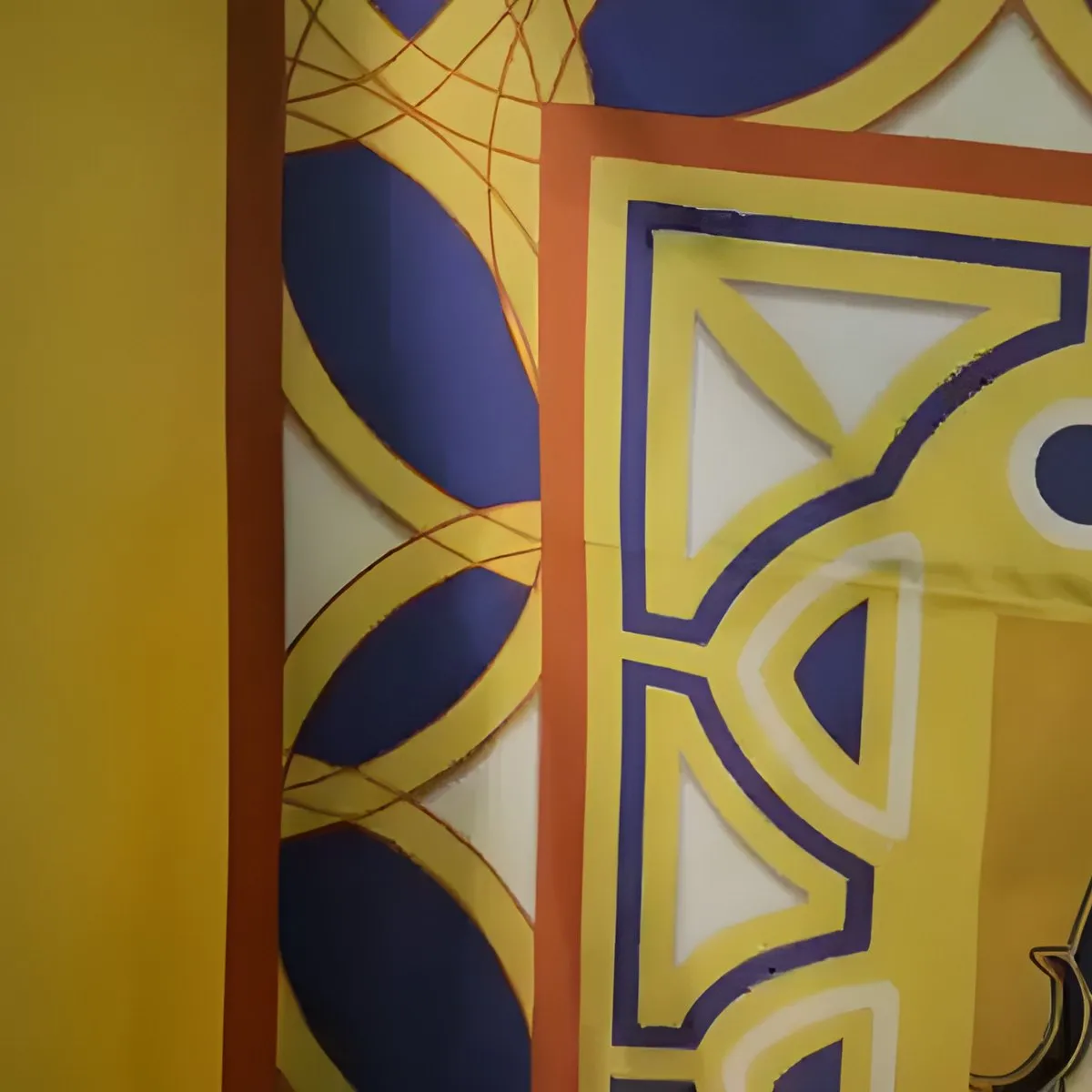
Twill is one of the three basic weaves. The Getty’s art vocabulary defines it as a textile “characterized by parallel diagonal ridges or ribs, produced by passing the weft threads over one and under two or more threads of the warp”. Because the threads interlace less often than in a plain weave, twill drapes well, and Boston’s Museum of Fine Arts notes it gives “parallel, diagonal ribs on the front and a smooth face on the back”. That smooth, dense surface takes a fine print, which is why most luxury squares are silk twill.
Other silk fabrics you’ll see on scarf labels:
| Fabric | Weave | What it’s like |
|---|---|---|
| Silk twill | Twill | Diagonal ridges, dense, drapes well; the classic printed square |
| Satin and charmeuse | Satin | “A lustrous face and dull, crepe back” (Getty, on charmeuse); slippery and shiny |
| Habotai (habutai) | Plain | “A soft, plain weave fabric”, “originally woven in Japan” (MFA Boston); light and smooth |
| Crepe de chine | Plain | Light, with hard-twisted yarns that give a fine pebbled surface (Britannica) |
| Chiffon | Plain | “Sheer, lightweight plain-woven textile of fine, tightly-twisted yarn” (Getty) |
What momme means
Momme (written mm or m/m) is a Japanese unit. As a plain weight it’s 3.75 grams, still used in Japan by law for weighing pearls. For silk fabric it means weight per area, and there isn’t one agreed conversion: unit registries give 4.340 grams per square metre (from the old rule of a 45-inch by 100-yard piece weighed in pounds), while the Chinese silk trade uses 4.3056. Either way, a higher number means more silk in the same square, not better silk.
| Momme | Grams per m² (about) | Silk in a 90 cm square (about) |
|---|---|---|
| 12 | 52 | 42 g |
| 16 | 69 | 56 g |
| 18 | 78 | 63 g |
Our arithmetic, at 4.34 g/m². The six squares in our check that state a weight are 12 momme (Manipuri, Oliver Wilkinson), 16 (Tang Heritage, SinoCultural), 17.5 (Silver & Riley) and 18 (Aubrey Kurlansky). None states more than 18, and none of the ten fashion houses states one.
Momme is weight, not quality. A higher number means more silk in the square.
What a hand-rolled hem is
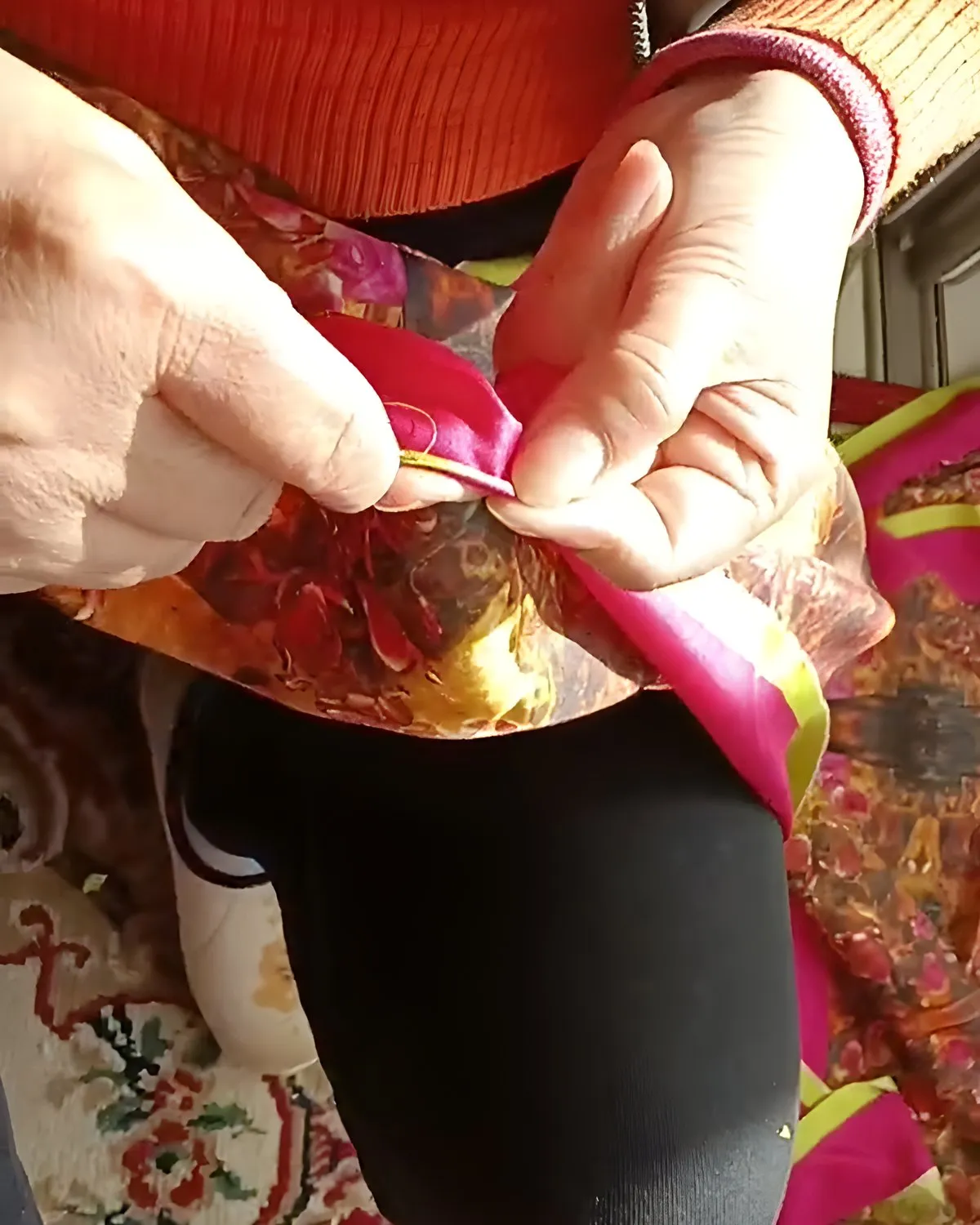
A hand-rolled hem is the edge of the silk rolled tight by hand and held with small stitches, so it stays soft and rounded. No museum or standards body defines it; the best descriptions come from makers. The Como house Mantero describes a seamstress rolling the edge “under her expert fingers, obtaining a thin roll which must be consistent and slightly puffed”, and French makers call it roulotté. The V&A uses the term “hand rolled hem” in its catalogue of printed scarves.
How to tell one, according to makers (so treat it as a guide): a hand-rolled hem is plump and rounded, with small, slightly uneven stitches; machine hems, Echo notes, “usually have machine hems, most often with one line of stitching”, and Rampley & Co says they come out flattened. “Hand-finished” or “hand-sewn” on a page doesn’t necessarily mean rolled.
Printed on both sides
Most silk squares are printed on one face, so the back shows paler. A square printed on both sides shows the design wherever it falls, which matters in knots and drapes where the back shows. Seven of the 51 we checked say so; one fashion house, Loewe, uses a double-face twill with a different colourway on each side.
Mulberry silk and “6A”
Mulberry silk comes from the domesticated silkworm Bombyx mori, which “solely feeds on the leaves of mulberry plant”, according to the International Sericultural Commission; almost all commercial silk is this kind. It isn’t a legal category: UK and EU law knows only “silk”. “6A” is a grade for raw silk yarn in China’s national standard (GB/T 1797-2008), not a grade for a finished scarf.
What a silk label must say, US and UK
- United States. Scarves are covered by the Textile Fiber Products Identification Act. The label must give the fibre’s generic name and percentage, the maker’s name or FTC registration number, and the country of origin. “100% silk” or “all silk” is allowed only if it is entirely silk: the FTC’s 3% tolerance doesn’t apply to single-fibre claims (16 CFR 303.43). Online listings must say whether a product is “made in USA”, “imported” or both (303.34).
- United Kingdom. Under the retained textile regulation, silk is “fibre obtained exclusively from silk-secreting insects”; “100%”, “pure” or “all” is allowed only for one fibre, with up to 2% stray fibre tolerated (Article 7), and online shoppers must see the fibre content before they buy. Country of origin isn’t required.
- Neither country requires the weight, the weave, the hem or the print sides. That’s why most labels don’t give them.
How to tell if a silk scarf is real
Start with the label: “100% silk” is a legal claim in both the US and the UK. Beyond that, the burn test is the standard check, done on a single loose thread, never the scarf itself. The Canadian Conservation Institute’s table says silk “shrivels away from flame, burns slowly, self-extinguishes, smells like burning hair” and leaves “a very small dark bead-like mass that breaks apart easily”. Do it with tweezers over a non-flammable surface, away from anything that can catch, with water nearby. And the CCI’s caveat: “neither a burn test nor a microscopic identification is regarded as conclusive on its own.” The ring test and the water-drop test aren’t backed by any source we found.
Common claims, checked
- “The hem is always rolled toward the front.” You may also read “toward the back”; makers’ traditions differ.
- “US and UK law allow 3% non-silk in a ‘100% silk’ scarf.” The US allows none for a single-fibre claim; the UK allows up to 2% stray fibre.
- “A $500 scarf uses Grade 6A silk.” 6A grades raw yarn, and none of the fashion houses we checked states a grade at all.
FAQ
What is silk twill? Silk twill is silk woven so the threads form fine parallel diagonal ridges, with a smooth back. It’s dense, drapes well and takes a sharp print, which is why most printed silk squares are silk twill.
Is silk twill better than silk satin for a scarf? For a printed square, usually yes. Twill is matte, holds a knot and prints crisply; satin and charmeuse are shinier and slippery, with a dull back. Habotai and chiffon are lighter plain weaves.
What momme is best for a silk scarf? Printed silk squares that state a weight are usually 12 to 18 momme. A higher momme means more silk: an 18 momme 90 cm square holds about 63 g of silk, a 12 momme one about 42 g. Momme measures weight, not quality.
What does hand-rolled mean on a silk scarf? The edge is rolled tight by hand and held with small stitches, giving a soft, rounded hem rather than a flat machine-stitched one. Of 51 silk squares we checked, 27 say their hems are hand-rolled.
Are silk scarves printed on both sides? Most aren’t: the back shows paler. Seven of 51 squares in our check say they’re printed on both sides, including Aubrey Kurlansky’s, Jessie Zhao’s and Lilysilk’s.
What is mulberry silk? Silk from the domesticated Bombyx mori silkworm, which feeds only on mulberry leaves. Almost all commercial silk is mulberry silk; it isn’t a separate legal category in the UK or EU.
How can you tell if a scarf is 100% silk? Check the label: “100% silk” is a legal claim in the US and UK. A burn test on one loose thread is the usual home check (silk burns slowly, self-extinguishes, smells like burnt hair and leaves a crushable bead), but conservators say it isn’t conclusive on its own.
What does a silk scarf label have to say? In the US: fibre name and percentage, the maker’s name or registration number, and the country of origin. In the UK: the fibre composition. Neither requires the momme, weave, hem or whether it’s printed on both sides.
Sources
Weaves: Getty Art & Architecture Thesaurus (twill), Getty (charmeuse), Getty (chiffon), MFA Boston CAMEO (twill), CAMEO (habutai), Britannica (crepe de chine). Momme: Japan’s Measurement Act order, QUDT unit registry. Hems: Mantero, V&A collections, Echo, Rampley & Co. Silk: International Sericultural Commission, GB/T 1797-2008. Labels: 15 U.S.C. 70b, 16 CFR Part 303, FTC guide, Regulation 1007/2011 as retained in UK law. Burn test: Canadian Conservation Institute, CAMEO. Counts: our dataset of makers’ own pages, checked 17 October 2026. All checked 17 October 2026.