Silk scarves
How to Tie a Silk Square Scarf: 12 Ways, and Which Size Each One Needs
Twelve ways to tie a silk square, from the neck knot to the headscarf, and why a 90 cm and a 70 cm square suit different ties.
Which size square should you buy?
3 questions, 15 seconds.
Question 1 of 3
Where will you wear it most?
Question 2 of 3
Do you want a headscarf that ties at the back of the neck?
Question 3 of 3
One square, or a few?
Your answer
The 90 cm square
It's the only size for the kerchief, shawl, scarf top, belt and a headscarf tied at the nape, and it still knots at the neck. Aubrey Kurlansky's 90 cm squares are from $219 (£169): limited editions in 18 momme silk twill, printed on both sides, hand-rolled.
See the 90 cm squaresYour answer
The 70 cm square
It does the neat neck knot, choker, headband, ponytail and bag handle, without the bulk. Aubrey Kurlansky's 70 cm squares are $155 (£125), in the same 18 momme silk twill, printed on both sides.
See the 70 cm squaresYour answer
One of each
A 70 cm for the neck and hair, a 90 cm for everything else. Two pieces from Aubrey Kurlansky's collection are 10% off together, three or more 15% off.
See all the squaresGet 20% off a first order
We'll email you a personal 20% code for your first order, then new designs as they arrive.
One email with your code, then new designs. Unsubscribe any time.
To tie a silk square, fold it first and knot it second: into a long band for the neck, hair or waist, or into a triangle for a kerchief, headscarf or top. Which ties you can actually do depends on the square’s size. Folded corner to corner, a 90 cm (35 in) square makes a band 127 cm (50 in) long; a 70 cm (27.5 in) square makes one of 99 cm (39 in). That 28 cm difference is why one size knots neatly at the throat and the other wraps a waist or covers the hair and still ties at the nape.
The pages that rank for this question show the ties but rarely the size. None of the top articles gives the size tie by tie. Only one maker puts a number on it: around the neck, says Misciano, “the 70x70 silk square makes two turns as a band and the 90x90 square three.” So below, each of the 12 ties comes with the size it needs, and the reason.
Which size suits which tie
| Tie | 70 cm (27.5 in) | 90 cm (35 in) |
|---|---|---|
| 1. Bias band at the neck | Yes, neater | Yes |
| 2. Double-wrap choker | Best | Bulky |
| 3. Cowboy (front triangle) | A neat bandana | A full, dramatic one |
| 4. Neck bow | A small bow | Best |
| 5. Kerchief drape | Too short to cross | Best |
| 6. Shoulder shawl | No | Yes |
| 7. 1950s headscarf | Knots under the chin only | Best, ties at the nape |
| 8. Headband | Best | Bulky |
| 9. Ponytail or bun | Best | Bulky |
| 10. Scarf as a top | No | Yes |
| 11. Belt | Only on a small waist | Yes |
| 12. Bag handle | Works (a pocket square is easier) | Bulky |
Where a maker or stylist states the size, we link them in that tie’s section. The rest follows from the band lengths below, or is our styling judgement, and we say which.
Why the size decides the knot
Almost every tie starts with one of two folds, and the fold sets your length.
- The band. Lay the square flat, fold two opposite corners to the centre, then fold from the long edge until you have a band 3 to 5 cm wide (Misciano’s advice for most neck knots). The band runs along the square’s diagonal: 127 cm from a 90 cm square, 99 cm from a 70 cm square.
- The triangle. Fold corner to corner. The long edge is the same diagonal, and the point hangs half of it: about 64 cm on a 90, 50 cm on a 70.
The waist shows what that means. The average US woman’s waist, measured where a belt sits, is 98.4 cm, according to the CDC’s national body measurements (2015–2018, women aged 20 and over). A 70 cm square’s 99 cm band reaches round it with almost nothing left to knot; a 90 cm square’s leaves about 29 cm for a knot or a bow.
A 90 cm square gives you 127 cm of band; a 70 cm square gives you 99. Everything else follows from that.
One more thing the tutorials skip: in most of these ties the back of the silk shows, at the ends of a band, inside a bow, on a kerchief’s folded edge. A square printed on one side shows a paler reverse there; one printed on both sides doesn’t.
At the neck
1. The bias band (the classic knot)
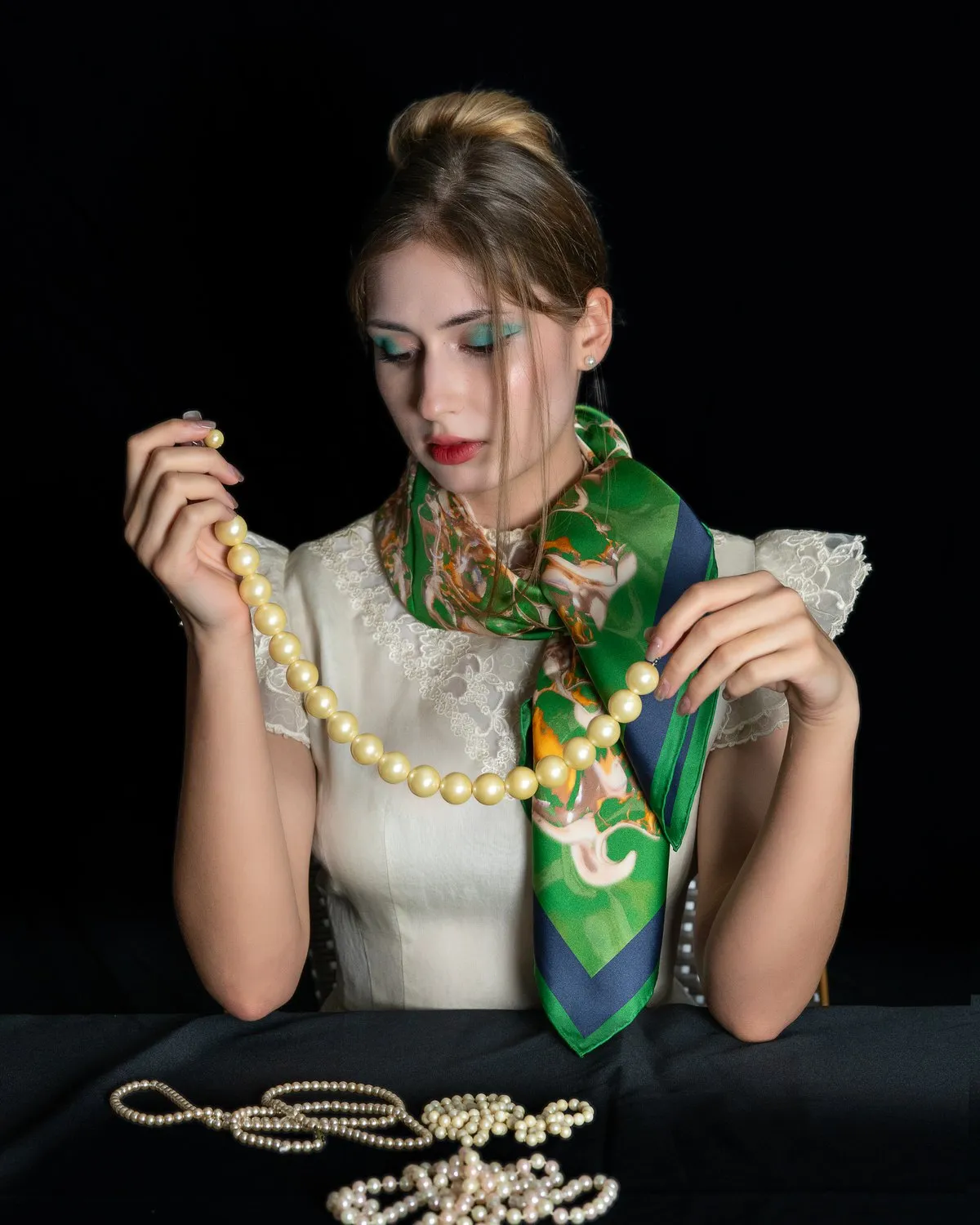
Make the band (3 to 5 cm wide). Centre it at the front of your neck, cross the ends behind and bring them forward. Knot once at the side, then flatten the knot with your fingertips so it lies smooth. For a looser look, fold the band in half, put it round your neck and pull both ends through the loop.
Size: both work. A 70 cm square sits neater; a 90 cm leaves longer ends or room for a second turn, per Misciano’s two turns against three.
2. The double-wrap choker
Make a narrower band, about 3 cm. Wrap it twice round the neck so it lies flat, then tie a small knot or half-bow at the side and tuck the ends in.
Size: 70 cm. “For neck knots (bandana, choker), a small square is ideal,” says the Paris publisher Inoui Editions.
3. The cowboy (front triangle)
Fold a triangle and lay it point-down on your chest. Cross the two ends behind your neck, bring them forward and knot them over or under the point. To shorten it, roll the long edge once before you tie.
Size: both. A 70 cm makes a neat bandana (Inoui again); a 90 cm makes a fuller, more dramatic triangle.
4. The neck bow
Make a wider band, 6 to 8 cm (the width Misciano gives for its short bow). Tie a loose first knot at the side, then make two loops like a shoelace and tighten by pulling the loops, not the ends.
Size: 90 cm. Our judgement: after one turn round the neck, a 127 cm band leaves enough for two full loops and ends; a 99 cm band makes a small bow.
5. The kerchief drape
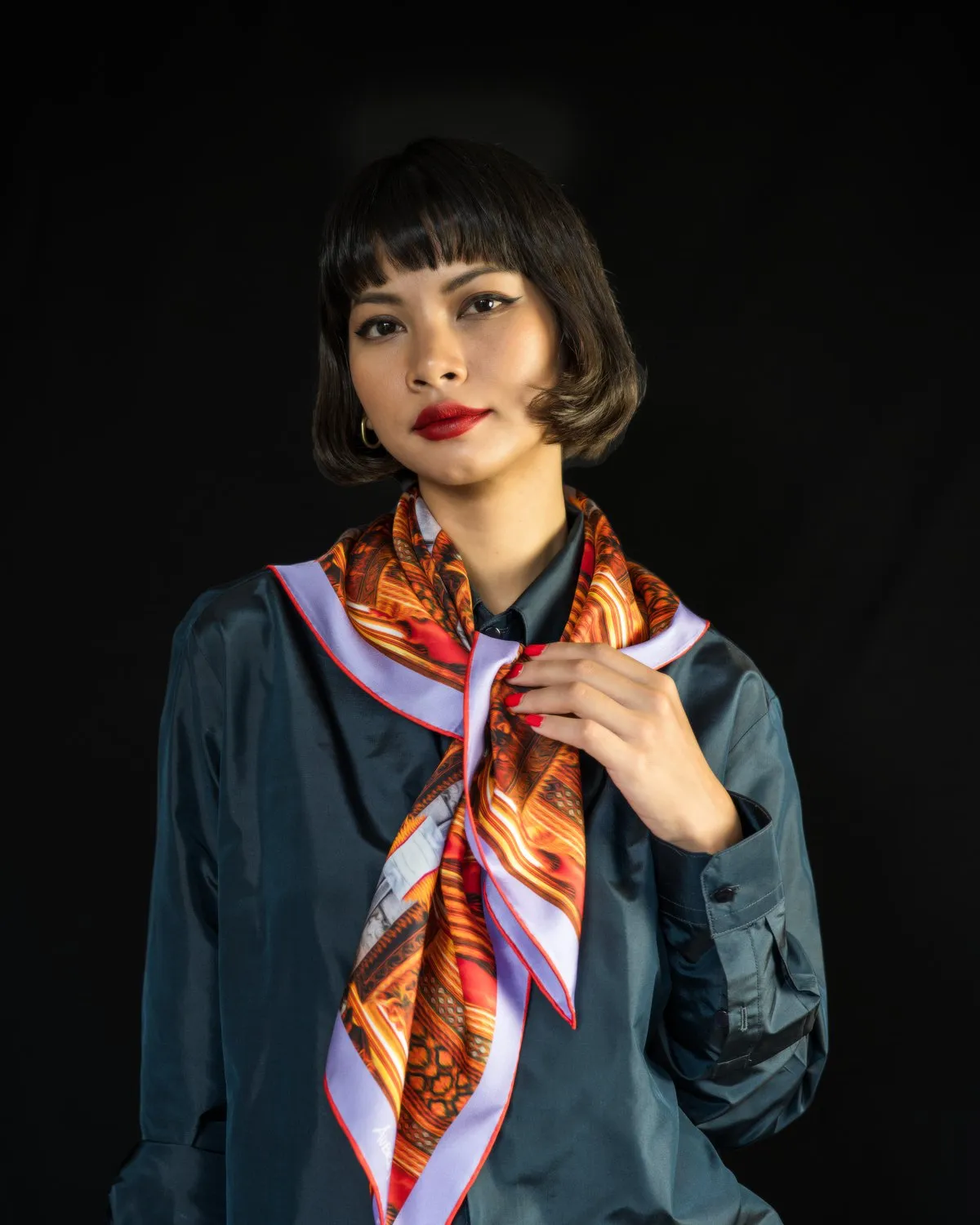
Fold a triangle and put the point at the centre of your chest. Take the two corners round the back of your neck and bring them forward over the opposite shoulders, or knot them loosely at the front. Without a knot, the tension holds it.
Size: 90 cm. The Met Store suggests “an oversized scarf” for this one; a 70 cm triangle is too short for the corners to cross and come back.
6. The shoulder shawl

Fold a triangle and put it over both shoulders with the point down your back. Bring the two corners to the front and knot them loosely at the chest, or tie them at the small of your back for a bolero.
Size: 90 cm. Our judgement for the shawl: a 70 cm triangle barely covers the shoulders. For the bolero, “this one has to be a very large square to work!” notes The Wardrobe Consultant.
In the hair
7. The 1950s headscarf

Fold a triangle. Lay the long edge along your hairline with the point at the back. Cross the ends under your chin and tie them at the nape of your neck. Your face stays fully uncovered. It’s the 1950s look: by then the headscarf was worn by everyone “from filmstars like Marilyn Monroe to housewives”, says the V&A (more in our history of the printed silk scarf).
Size: 90 cm. “An oversized scarf works best for this look,” writes the designer Gina Maldonado. A 70 cm triangle can still frame the face, but only knotted under the chin.
8. The headband

Fold a band 4 to 6 cm wide. Put it under your hair at the nape, bring the ends up over the crown and knot on top or at the side. For the twisted version, twist the ends once at the crown and tie them at the back.
Size: 70 cm. The twisted headband needs a square “at least 27×27″,” says The Fox & She, and 70 cm is 27.5 in. A 90 cm square makes a bulky knot.
9. The ponytail or bun
Fold a narrow band. Wrap it twice round the hair tie and finish with a knot or a bow, leaving the ends to hang.
Size: 70 cm. Our judgement: a 90 cm band is long enough but bulky in a small knot.
As a top, a belt or on a bag
10. The scarf as a top

For a halter, fold a triangle, put the long edge across your chest with the point down, tie the two corners behind your back, then lift and tie at the neck. For the version above, drape the triangle over your shoulders and knot the corners at the front.
Size: 90 cm only, by our judgement: a 70 cm triangle doesn’t reach round the body with enough left to tie.
11. The belt
Fold a band, thread it through your belt loops or wrap it at the waist, and knot or bow it at the hip.
Size: 90 cm. By the CDC figures above, a 70 cm band only knots on a waist well under the average; a 90 cm band leaves about 29 cm for the knot.
12. The bag handle
Knot one end at the base of the handle, wrap the band tightly up the handle, and knot it again at the other end. The same wrap works round the wrist.
Size: the smaller the better. “Small squares (40–50 cm) are ideal for wearing around the neck or on a bag,” says Maison de la Soie, so a pocket square suits it best; a 70 cm square still works, and a 90 cm makes a thick, lumpy handle.
Which size to buy first
If you’ll wear it mostly at the neck or in your hair, buy the 70 cm. It does the choker, headband, ponytail and bag, and the classic band sits neater. If you want one square to do everything, buy the 90 cm. It’s the only size for the kerchief, shawl, top, belt and a headscarf that ties at the nape, and it still does a neck knot with longer ends. For winter, a long scarf wraps twice under a collar; our winter guide compares long scarves and squares.
Aubrey Kurlansky’s silk squares come in both sizes: 90 cm from $219 (£169) and 70 cm for $155 (£125), in 18 momme silk twill, printed on both sides, with hand-rolled hems. Each is a limited edition, never mass produced: made to order in collaboration with the artist and finished by hand, and it reaches the US in 2 to 3 weeks. See the squares.
FAQ
What size silk scarf is best for tying around the neck? Both main sizes work. A 70 cm (27.5 in) square makes a neat band that wraps twice; a 90 cm (35 in) square makes a band 127 cm long that wraps three times or leaves longer ends and room for a bow. For a choker or bandana knot, the smaller square is easier.
Is a 70 cm or 90 cm silk scarf better? It depends on how you’ll wear it. The 70 cm suits neck knots, headbands, ponytails and bags. The 90 cm is the only size for a kerchief drape, shoulder shawl, scarf top, belt or a headscarf tied at the nape, and it still ties at the neck. If you buy one, buy the 90 cm.
How do you wear a 35 inch square scarf? A 35 inch square is the classic 90 cm size. Fold it corner to corner into a 127 cm band for neck knots, bows or a belt, or into a triangle for a kerchief, a shoulder shawl, a scarf top or a 1950s headscarf tied at the nape.
Can you use a 70 cm silk scarf as a belt? Only on a small waist. Folded into a band, a 70 cm square is 99 cm long, and the average US woman’s waist is 98.4 cm (CDC, 2015–2018), so there’s usually nothing left to knot. A 90 cm square leaves about 29 cm.
How do you tie a silk scarf like a French woman? The look usually means the bias band: fold the square into a band 3 to 5 cm wide, wrap it once round the neck and knot it at the side, then flatten the knot so it lies smooth. It works with a 70 cm or a 90 cm square.
How do you keep a silk scarf from slipping? Flatten the knot rather than pulling it tight, tie it at the side of the neck, or tuck the band under a collar. In the hair, a narrow band tied over the crown holds better than a wide one.
How do you tie a silk scarf on your head? For the 1950s headscarf, fold a triangle, lay the long edge along your hairline with the point at the back, cross the ends under your chin and tie them at the nape. It needs a 90 cm square; a 70 cm square only knots under the chin. For a headband, use a narrow band from a 70 cm square.
How do you tie a scarf on a bag? Fold a narrow band, knot one end at the base of the handle, wrap it tightly up the handle and knot it at the other end. A pocket square or a 70 cm square works best; a 90 cm square is too bulky.
Sources
Band and triangle lengths are our arithmetic from each square’s diagonal. Waist: CDC, NCHS Vital and Health Statistics Series 3, No. 46, Table 19 (women 20 and over, mean 98.4 cm). Size advice quoted from Misciano, Inoui Editions, The Met Store, The Wardrobe Consultant, The Fox & She, Gina Maldonado and Maison de la Soie, checked 17 October 2026.