Silk care
How to Frame a Silk Scarf: Frame Sizes, Safe Methods and Costs
A framed silk scarf needs a frame about 100 cm (40 in) square for a 90 cm scarf, not 36 in. Sizes, the museum method, magnetic kits and costs.
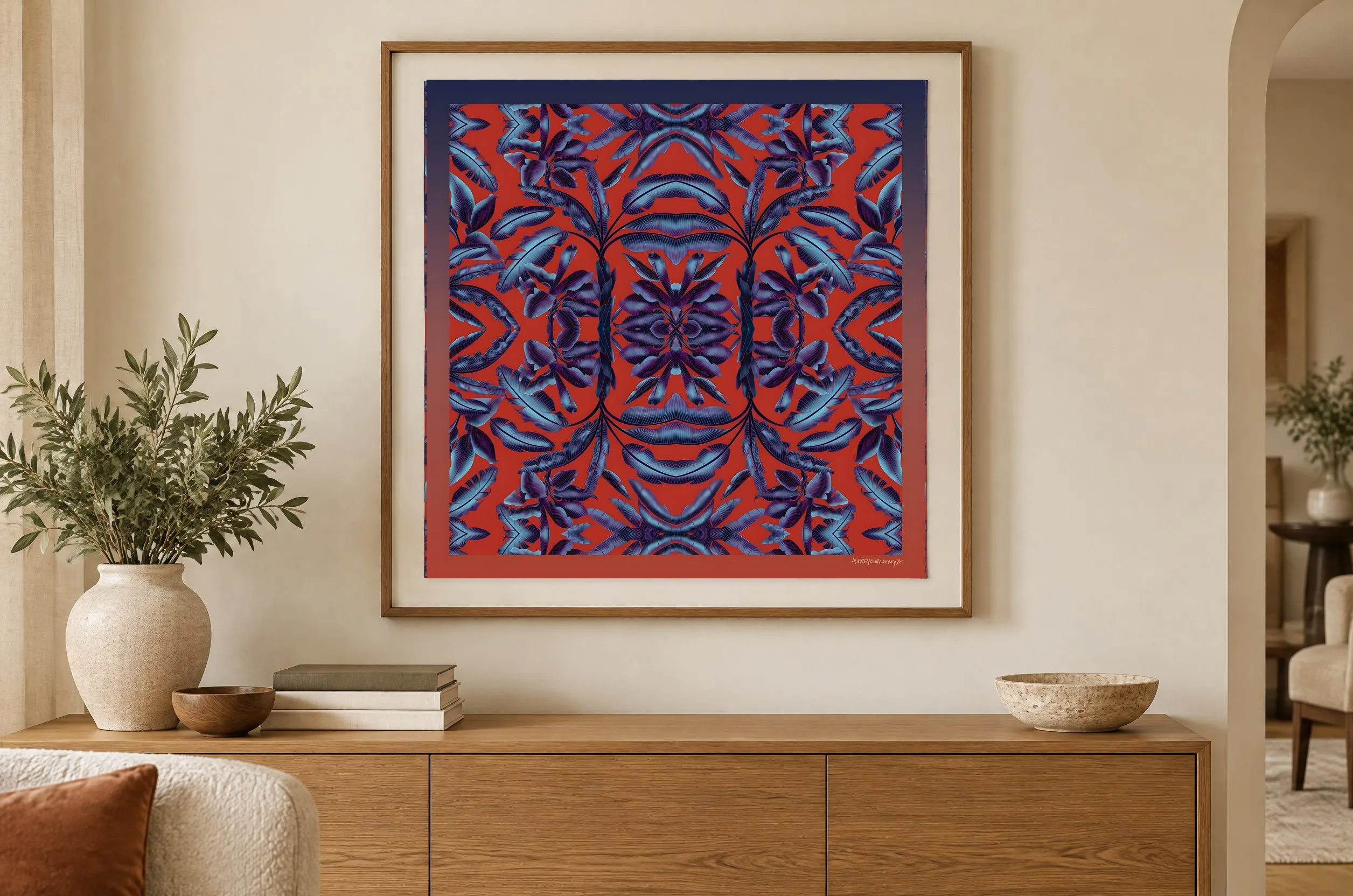
Should you frame your scarf, or wear it?
3 questions, 15 seconds.
Question 1 of 3
What's the scarf to you?
Question 2 of 3
Where would it hang?
Question 3 of 3
Is it old or fragile?
Your answer
Frame it like a museum would
Stitch it to a cotton-covered acid-free board a few centimetres bigger than the scarf (about 100 cm for a 90 cm square), use UV-filtering acrylic with a spacer, and hang it out of the sun. Aubrey Kurlansky's squares are limited editions, made to order and finished by hand, with hand-rolled hems that a stitched mount shows off. See them shown framed; frames aren't included.
See them shown framedYour answer
Wear it, and rest it
A scarf you wear is resting most of the time. Store it flat or rolled in acid-free tissue, away from light. Aubrey Kurlansky's squares are printed on both sides, so they look right however they fall.
See Aubrey Kurlansky's squaresYour answer
See a textile conservator first
The Canadian Conservation Institute says stained, split or fragile textiles should go to a professional textile conservator before framing. For a new scarf to frame, Aubrey Kurlansky's 90 cm squares are from $219 (£169).
See Aubrey Kurlansky's squaresGet 20% off a first order
We'll email you a personal 20% code for your first order, then new designs as they arrive.
One email with your code, then new designs. Unsubscribe any time.
To frame a silk scarf without damaging it, do what museums do: stitch it to an acid-free board covered in washed cotton, a few centimetres bigger than the scarf all round, frame it behind UV-filtering acrylic held off the silk by a spacer, and hang it where the sun never reaches. For a 90 cm scarf that means a frame about 100 cm (40 in) square. No tape, glue, staples, pins through the silk or dry-mounting. A framer will charge about $460 to $830 for a 90 cm scarf in the US, or £180 to £850 in the UK, in our check of framers’ own pages on 29 October 2026.
Two findings change the usual advice. A 36 × 36 inch frame, the obvious buy for a 35-inch scarf, is only 91.4 cm across: 7 mm a side, about what a frame’s lip covers, and no room for a board to stitch to. And UV-filtering glass, which most framing guides treat as the main protection, barely slows fading on its own. The light level does, so where you hang a framed scarf matters more than how you frame it.
Below: the frame size for every common scarf, the museum method step by step, what the magnetic, acrylic and kit frames sold for scarves say about themselves, and what framers charge.
The short answer
| Method | Safe for silk? | Who should do it |
|---|---|---|
| Stitched to a fabric-covered board | Yes, and reversible | You, carefully, or a framer |
| Pressure mount (pressed between padded board and acrylic) | Yes | A textile conservator only |
| Magnetic scarf frame kit | Reversible, no adhesive; makers don’t say whether the acrylic touches the silk | You, after asking the maker |
| Acrylic “floating” frame (scarf between two sheets) | Acrylic on the silk, which museums leave to conservators | |
| Lacing over a board | For sturdy fabric; not for hand-rolled hems | A framer |
| Pins through the silk | No | |
| Tape, glue or spray adhesive | No | |
| Dry-mounting (heat-pressed onto board) | No | |
| Hung by its edge from clips, tacks or a magnetic bar | Not for silk |
Sources: the Canadian Conservation Institute (CCI), the Textile Museum at George Washington University, the US National Park Service and the FACTS framing standard; for the frame rows, the makers’ own pages, below. The lacing line is our reading for scarves with hand-rolled hems.
What size frame does a silk scarf need?
About 100 cm (40 in) square for a 90 cm scarf. The frame goes round the board, not the scarf, and the board should be “a few centimetres larger all around than the piece”, in the words of the CCI’s mounting note. We use 3 to 5 cm a side, so the board, and the opening the frame takes, is 6 to 10 cm bigger than the scarf each way.
| Scarf | Board and frame size (scarf + 3 to 5 cm a side) | In inches | Scarf-frame makers’ sizes |
|---|---|---|---|
| Pocket square, 42 × 42 cm | 48 to 52 cm square | 19 to 20.5 in: a 20 × 20 in frame | Arts & Artisan Scarf 45: 52 cm (20.5 in), for 42 to 45 cm |
| Small square, 70 × 70 cm | 76 to 80 cm square | 30 to 31.5 in: a 30 × 30 in frame | Arts & Artisan Scarf 70: 75 cm (29.5 in), for 66 to 70 cm |
| Square, 90 × 90 cm | 96 to 100 cm square | 38 to 39.5 in: a 40 × 40 in (101.6 cm) or 100 × 100 cm frame. Not 36 × 36 in | Elysian Frame: 100 × 100 cm. Arts & Artisan Scarf 90: 98 cm (38.6 in), for 88.5 to 90 cm |
| Long scarf, 65 × 180 cm | 71 to 75 × 186 to 190 cm | 28 to 29.5 × 73 to 75 in: custom only | None found. Framebridge’s largest size, 40 × 60 in (102 × 152 cm), is too short |
Measure your own scarf before you buy anything. Hand-rolled hems vary: Hermès gives one of its 90 scarves as 34.8 × 34.8 inches (88.4 cm) and adds, “As this scarf is hand-rolled, the dimensions indicated may vary.”
Does a 36 × 36 inch frame fit a 90 cm scarf?
Only edge to edge, with nothing to spare. 36 inches is 91.4 cm, which leaves 7 mm a side round a 90 cm scarf. A frame’s lip “typically covers about 1/4 inch of the artwork on each side”, Frameology says, which is about 6 mm. The silk would fill the opening, with no border of board to stitch it to. By our 3 to 5 cm rule, a 36 inch frame suits a scarf of about 81 to 85 cm. Wexel Art sizes the same way: its floating frame for 36 × 36 inch scarves measures 40 × 40 inches.
The light rule: UV glass isn’t the main fix
Of the natural fibres, “silk is the most vulnerable” to light, according to the CCI. Its fading table for light-sensitive colours shows why the glass matters less than the room:
| Where it hangs | Light | Time to a just-noticeable fade, UV filtered |
|---|---|---|
| By a window, or under a desk lamp | 5,000 lux | 5 days to 2 months |
| A museum textile gallery | 50 lux | 1.5 to 20 years |
Filtering out UV, the CCI says, has “a beneficial but much more limited effect”; cutting the light from 5,000 to 50 lux “will prolong the enjoyment of colours by a factor of 100”. That’s why museums keep textiles at 50 lux: the Museums Association tells UK museums to “Limit light levels to 50 lux and install UV protection” and to “Never show textiles in direct sunlight”. A home won’t be that dim, but you can choose a wall the sun never crosses. The CCI’s advice is to watch where the sun falls “at different times of the day and avoid those locations”, and to keep away from fireplaces, radiators and vents.
UV glass alone barely slows fading. Less light does.
Why a scarf isn’t a print
A print is paper, and framers can hinge it, mat it or dry-mount it. A silk scarf is a textile: it moves with humidity, its edges are often rolled and stitched by hand, and anything sticky or heat-set stays in it for good. The CCI lists “glues, adhesive tapes, adhesivecoated boards” and “staples, tacks, nails” among things that must never touch a framed textile. The FACTS standard is plainer still: “Textiles shall not be mounted with adhesives.”
The museum method is also reversible. The CCI says a stitched mount on a fabric-covered board “is easily reversed without damaging the textile”, which matters if you might want to wear the scarf again.
Step by step: the museum mount
This follows the CCI’s method for mounting small, light, flat textiles. For an old, stained or fragile scarf, the CCI says to see a textile conservator first.
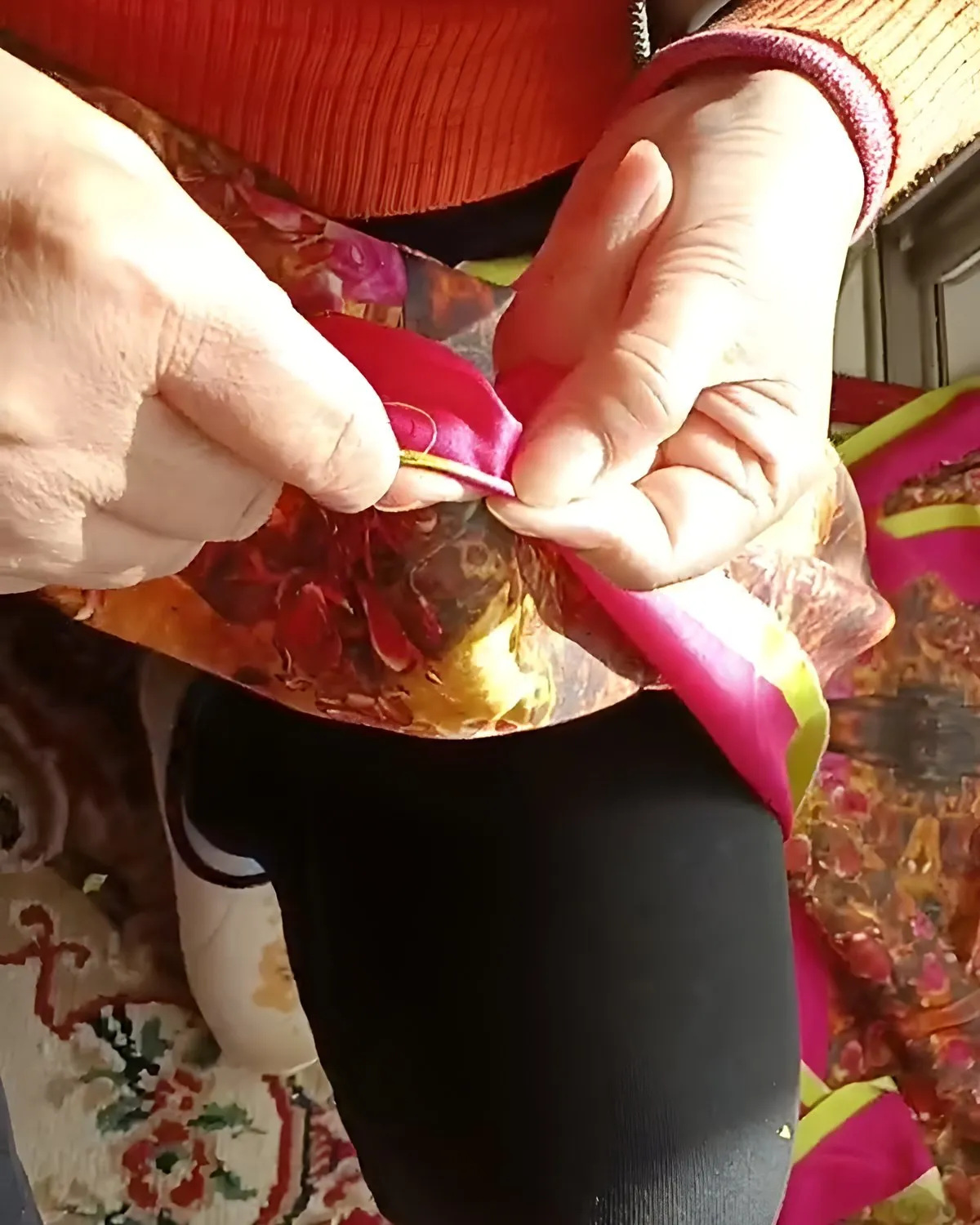
- Check the scarf. It should be clean and sound, with no splits or stains.
- Cut a board of acid-free museum board or archival foam board, a few centimetres bigger than the scarf all round (sizes in the table above). For a 90 cm square that’s about 96 to 100 cm, larger than a standard 32 × 40 inch sheet.
- Cover it with plain cotton, washed first, pulled taut and fixed only on the back. Not linen: the Textile Museum says “Linen is not an appropriate mount fabric” because it absorbs moisture and sags.
- Lay the scarf on and hold it with a few pins placed between the threads, temporarily.
- Stitch it down. A small stitch on top of the silk, a long one underneath; the CCI says “a blind stitch can be used on hemmed edges”. Add a few staggered lines of tiny support stitches across larger plain areas. Don’t pull the thread tight. Use cotton or fine silk thread.
- Never wrap the scarf round the board. The National Park Service says to “never … turn part of the textile over the edge of the stretcher”; for a scarf it also hides the hand-rolled hem.
- Frame it in a frame that takes the board, with a spacer between the silk and the glazing. FACTS sets the minimum gap at “one 4- ply matboard (0.045 inch; 2 mm)”. The Textile Museum notes that “acrylic is usually preferable to glass” for textiles; choose a UV-filtering grade.
- Hang it away from sun and heat, and not on a cold outside wall.
The exception to “keep the glazing off the silk” is a pressure mount, where the scarf is held by friction between a padded board and the acrylic. The Textile Museum says it “should only be attempted by a conservator”.
Magnetic, acrylic and kit frames compared
Magnetic frame kits keep two museum rules by their makers’ own account: nothing sticky, and the scarf comes out again. Acrylic “floating” frames break a third, by putting the acrylic on the silk. We judged each on its maker’s page alone, checked 29 October 2026.
| Product | What it is | How it holds the silk (maker’s words) | Glazing | Price |
|---|---|---|---|---|
| Arts & Artisan Scarf 90 | Magnetic frame kit, 98 cm | “Magnetic Strips”; “No pins or tape” | UV-protective acrylic; doesn’t say if it touches the silk | $310 (sale; $345 regular) |
| Elysian Frame | Magnetic frame kit, 100 cm | “Magnets framing system, no pins/holes”, “zero adhesives, 100% reversible” | UV-shield plexiglass; doesn’t say | $288 (sale; $340 regular) |
| The Abigail Frame | Magnet and bracket frame, 45 and 55 cm; 70 and 90 cm “Coming Soon” | A bracket system that “distributes pressure evenly to prevent dents or stretching” | UV-blocking plexi; doesn’t say | from $750 |
| Wexel Art floating frame | Two 40 × 40 in acrylic panels, the scarf between them | Between the panels | 98% UV, on the silk | $729.99 |
| LuxeDisplay floating frame | Two acrylic panels | The inner panel “should now lay nicely on top of the scarf” (its guide) | UV-blocking acrylic, on the silk | $299 (sale; $399 regular) |
| Fringe Scarves magnetic frame | Wooden bars with a rope hanger, 27 or 36 in | “magnetic backs to lock scarf into place” | None | $56 |
| Hermès scarf display system | Wall set: “five Clou de Selle magnets, four screws and five cables” | “securely fix your scarf to the wall” | None described | Listed on its Australian site; we found no US or UK listing |
Magnetic frame kits. None of the three makers says how far its acrylic sits from the scarf, and the museum rule is that the glazing doesn’t touch it. A magnetic frame also holds the silk at its edges, where the museum mount adds lines of support stitches across the middle. Ask the maker about the gap before you buy.
Acrylic floating frames. Museums press a textile under acrylic only as a pressure mount, over a padded, fabric-covered board, and the Textile Museum says that “should only be attempted by a conservator”. The Smithsonian warns that “Glazing materials in direct contact with the textile can cause damage”, and the Textile Museum that glass in close contact can cause condensation.
Magnetic hangers. Without glazing, the silk takes the room’s full light and dust. The Fringe bars hang a scarf by its edge, so the silk carries its own weight. Of the hanging method most conservators choose, a Velcro strip, the Textile Museum says it “is not appropriate for thin or fragile textiles, such as silk”.
Lit frames. Some scarf frames have built-in lights, such as LuxeDisplay’s magnetic LED frame. The CCI’s framing note says “It is also important to avoid attaching light fixtures to frames”.
What we’d do: for a scarf you’ll swap or wear often, a magnetic kit, once its maker confirms the acrylic doesn’t touch the silk. For a scarf that stays up for years, a stitched mount with a spacer, done by you or a framer. We’d keep silk you care about out of a floating acrylic sandwich.
What framing costs, US and UK
Prices from each framer’s own page, re-checked 29 October 2026. These are examples, not averages.
| Framer | What you get | Price |
|---|---|---|
| Elysian Frame (US, online) | Framing service plus its magnetic frame for a 90 cm scarf; UV acrylic; doesn’t say whether the acrylic touches the silk | $169.99 + $288 frame (sale) |
| Framebridge (US, in store) | Pieces up to 40 × 48 in; UV acrylic; doesn’t say how textiles are fixed | $550 |
| Big Apple Art Gallery (New York, New Jersey) | Scarves up to 40 × 40 in, hand-stitched | $785 |
| Wexel Art (US, mail-in) | 36 × 36 in shadowbox, UV acrylic; adhesive mount its terms call “not removable or reversible” | $829.99 |
| First4Frames (Falkirk) | 90 × 90 cm, stitched; standard glass, UV or anti-reflective from about £300 | from about £180 |
| Harten (UK) | Textiles laced over board, UV glass | from about £200 |
| SELVA London | Hand-sewn, perspex box; it adds a border of about 5 cm, so a 90 cm scarf finishes at 100 × 100 cm | £850 |
Of the four US framers, one uses an adhesive mount that can’t be undone, one doesn’t say how it fixes the scarf and one doesn’t say whether the acrylic touches the silk. So ask before you pay:
- How is the scarf held? You want “stitched to a fabric-covered board”. Not adhesive, dry-mounting or pins.
- Will the glazing touch the silk? It shouldn’t, unless it’s a conservator’s pressure mount.
- What glazing? UV-filtering acrylic or museum glass. Makers state up to 99% UV blocking, which still leaves visible light to fade the colours.
- In the UK, which Guild level? The Fine Art Trade Guild’s four levels of framing differ on fabric: Level 1 requires that “Processes must be fully reversible”, but Level 3 says “Dry-mounting may be used on fabric”. Ask for Level 1 or 2 by name.
Doing it yourself isn’t much cheaper at this size. Our materials list for a 90 cm scarf, priced on 17 October 2026, came to about $400 in the US and £500 to £1,000 in the UK, because board and UV acrylic come in big sheets and freight is costly. A magnetic kit for the 90 cm size costs $288 to $345 (above). DIY pays for a pocket square, or if you already own a suitable frame.
Or don’t frame it
Museums rest textiles after a few months on show: the CCI suggests “a three-month maximum”. A scarf you wear is resting most of the time anyway. Store it flat, or rolled in acid-free tissue, away from light.
For a wall without a frame, skip the tacks, clips and clamp bars that some guides suggest. A kimono can hang on a padded rod through its sleeves, which the Textile Museum recommends for “tunics, ponchos and kimonos”.
For quilts, tapestries and other heavier hangings, our guide to textile wall art covers the two methods museums use: a sewn sleeve on a rod, and hook-and-loop tape on a wooden batten.
A pocket square or handkerchief frames the same way as a scarf, on a board about 48 to 52 cm square, and a small sheet of UV acrylic keeps the cost down.
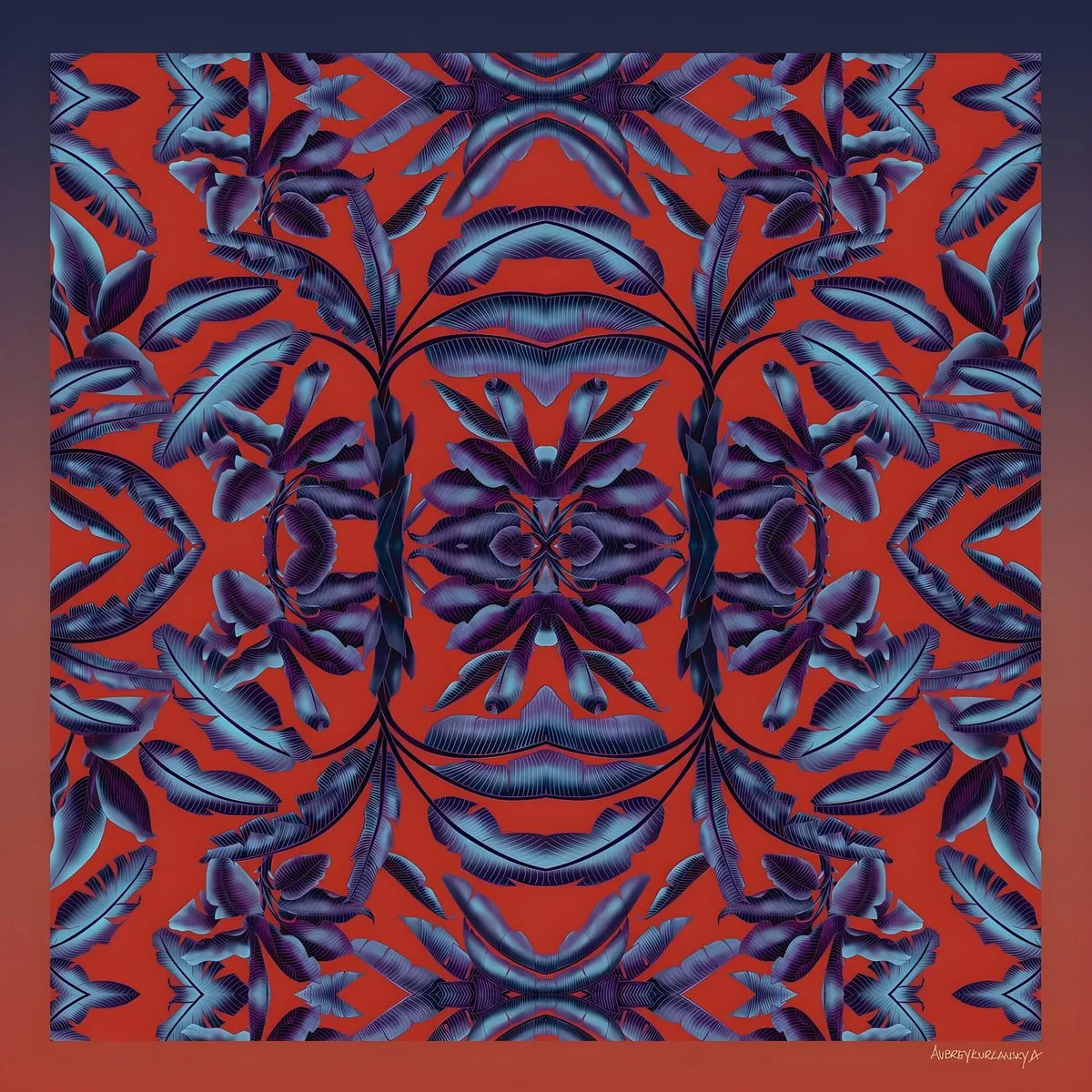
Aubrey Kurlansky’s 90 cm squares are 18 momme silk twill, printed on both sides, with hand-rolled hems. Each is a limited edition, never mass produced: made to order in collaboration with the artist and finished by hand. A stitched mount shows the hem, and because it’s reversible, you can take the scarf down and wear it. The size table above includes his other sizes too: 70 cm squares, 65 × 180 cm long scarves and 42 cm pocket squares.
See them shown framed; frames aren’t included, as The Kanso Collective sells the silk, not frames.
FAQ
What size frame does a 90 cm silk scarf need? About 100 cm (40 in) square. The scarf is stitched to a board a few centimetres bigger all round, 96 to 100 cm, and the frame takes the board. A 70 cm square needs about 76 to 80 cm, and a 42 cm pocket square about 48 to 52 cm.
Does a 36 × 36 inch frame fit a 90 cm scarf? Only edge to edge. 36 inches is 91.4 cm, which leaves 7 mm a side, about what a frame’s lip covers, so there’s no border of board to stitch the silk to. Use a 40 × 40 inch or 100 × 100 cm frame instead.
Can you frame a Hermès scarf without damaging it? Yes. Hermès describes its scarves as silk twill with hand-rolled edges, so a Hermès scarf frames like any silk square: stitched to a cotton-covered acid-free board, behind UV-filtering acrylic held off the silk, and hung out of the sun. Nothing glued, pinned through the silk or dry-mounted, so it can come out again.
How much does it cost to frame a silk scarf? In our check of framers’ own pages on 29 October 2026, a 90 cm scarf cost about $460 to $830 to frame in the US and about £180 to £850 in the UK. Magnetic frame kits you fill yourself cost $288 to $345 for that size. Ask how the scarf is held: stitched mounts can be undone, adhesive ones can’t.
Should a silk scarf be framed under glass? Yes, usually behind UV-filtering acrylic, which museums prefer to glass for textiles. Keep it at least 2 mm off the silk with a spacer, the FACTS framing standard’s minimum; only a textile conservator’s pressure mount puts the glazing on the silk.
Are magnetic scarf frames safe for silk? Their makers say they use no pins, tape or adhesive and that the scarf comes out again, which matches museum guidance. None of the three we read says whether the acrylic touches the silk, so ask before you buy. Acrylic floating frames do put the acrylic on the silk, which museums leave to conservators.
Can I glue, tape or pin a scarf into a frame? No. Conservation guidance rules out glue, tape, adhesive boards, staples and tacks touching a textile, and the FACTS framing standard says textiles “shall not be mounted with adhesives”. Pins only go between the threads, temporarily, while you stitch.
Will a framed silk scarf fade behind UV glass? Yes, more slowly. UV filtering helps, but light level matters far more: the Canadian Conservation Institute’s table shows light-sensitive colours fading noticeably in days to weeks by a window, against years at museum light levels.
Can you take a framed scarf out and wear it again? Yes, if it was stitched: the Canadian Conservation Institute says a stitched mount “is easily reversed without damaging the textile”, and magnetic frame makers say their frames are reversible too. Not if it was glued or dry-mounted: one US framer’s terms call its adhesive mount “not removable or reversible”.
How do you frame a pocket square or handkerchief? The same way as a scarf: stitch it to an acid-free board about 48 to 52 cm square, covered in washed cotton, and frame it behind UV-filtering acrylic with a spacer.
How long can a framed scarf stay on the wall? Museums rotate textiles; the Canadian Conservation Institute suggests a three-month maximum. At home, a low-light wall away from the sun matters most. Take it down for rests, or wear it.
What can I use instead of a frame? Wear and rotate it, store it flat, or hang a kimono on a padded rod. Avoid tacks, clips and clamp bars on silk.
Sources
Conservation: CCI Notes 13/17, conservation framing of flat textiles; CCI Notes 13/6, mounting small flat textiles; CCI, caring for textiles and costumes; The Textile Museum, George Washington University; National Park Service Museum Handbook, Appendix K (2002); Museums Association (2018); Smithsonian National Museum of American History, care of flags. Framing standards: FACTS, maximum preservation framing; Fine Art Trade Guild, four levels of framing (2021). Conservation sources checked 17 October 2026. Frame sizes: Frameology on the frame lip; Hermès, scarf 90 product page. Prices and frame products: each maker’s or framer’s own page, linked in the tables, checked 29 October 2026.